
HydroGraph Clean Power Stock: HGRAF Analysis, Graphene Technology and 2026 Outlook

Introduction
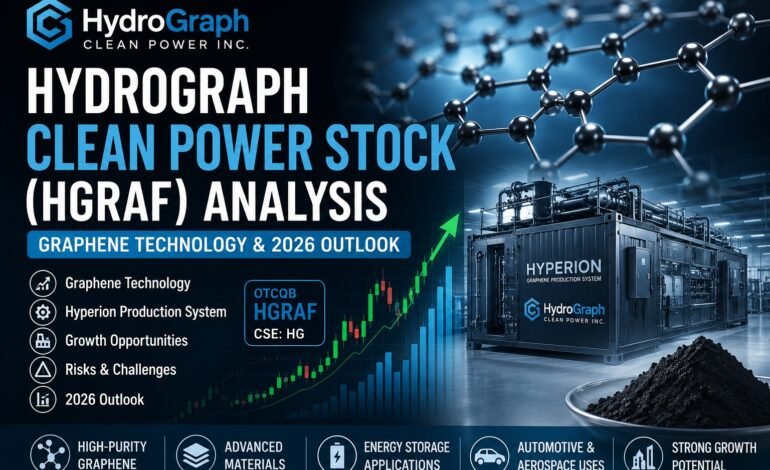
HydroGraph Clean Power has attracted attention from investors interested in graphene, advanced materials and emerging technology businesses. The company is different from a traditional power producer because its core business is focused on developing and manufacturing synthetic graphene and related carbon nanomaterials.
Its proprietary Hyperion System is at the center of the business. HydroGraph describes the platform as a patented detonation-synthesis process designed to produce high-purity graphene. The company says its material can be customized for different industrial applications, including composites, coatings, concrete, energy storage and other advanced-material uses.
For investors researching the attraction is largely connected to the potential growth of graphene applications. However, the investment case is not simply about whether graphene becomes more popular. Production costs, customer adoption, revenue growth, financing, manufacturing expansion and execution can all influence the company’s future.
Table of Contents
- What Is HydroGraph Clean Power?
- Stock Symbol and Market Information
- Understanding the Company’s Business
- Why Graphene Is Important
- The Hyperion Production Technology
- High-Purity Graphene and Manufacturing
- Potential Graphene Applications
- What Can Influence the Share Price?
- Understanding Historical Performance
- 2026 Outlook and Possible Scenarios
- Growth Opportunities
- Risks Investors Should Know
- Financial Metrics to Monitor
- How to Research the Company
- Frequently Asked Questions
- Final Outlook
What Is HydroGraph?
HydroGraph Clean Power Inc. is an advanced-materials company focused on synthetic graphene and carbon nanomaterials. The company was founded in 2017 and has developed proprietary technology intended to produce graphene at commercial scale.
The company is particularly known for its Hyperion System, which uses a controlled detonation process to create graphene. HydroGraph says the technology can produce material with 99.8% carbon purity and can be configured for different production requirements.
This business model gives HydroGraph exposure to a developing materials industry rather than the conventional electricity market. Its products may eventually become components in other products manufactured by industrial customers.
That creates both opportunity and uncertainty. If manufacturers adopt graphene at larger volumes, demand for reliable production could increase. If customers remain primarily in the research and testing stage, commercial growth may take longer.
For this reason, evaluating the company requires attention to both its technology and its ability to turn that technology into recurring business.
Stock Symbol and Market Information
HydroGraph’s shares are traded under different symbols depending on the market.
| Market | Symbol |
|---|---|
| Canadian Securities Exchange | HG |
| OTCQB | HGRAF |
The HGRAF ticker is commonly used by investors searching for U.S. market information. Searches for the company’s quote, daily price and share performance generally refer to this OTCQB listing.
The current market value can change during trading hours, so live pricing should be obtained from a current market-data provider. Historical prices are useful for understanding market behavior, but they should be considered alongside the company’s financial and operational progress.
For example, a change in valuation may occur because of a financing announcement, production milestone, customer development or broader sentiment toward small-cap technology companies.
Understanding the Company’s Business
HydroGraph’s business can be understood through three main areas: production technology, graphene manufacturing and commercial applications.
The first part is the technology used to produce graphene. The company has developed the Hyperion platform as its primary production method.
The second part is manufacturing. Even an effective production technology needs reliable facilities, equipment, raw materials, quality control and sufficient capacity to supply customers.
The third part is commercialization. Graphene has value when manufacturers can use it to improve an existing product or create a new one. This could include applications involving polymers, coatings, composites, concrete, batteries or other industrial materials.
This structure is important because commercial success depends on all three areas working together. A strong technology without customers is not enough, while strong demand without adequate production capacity can also limit growth.
Why Graphene Is Important
Graphene is a carbon-based nanomaterial known for a combination of physical and electrical characteristics that can be useful in specialized applications.
Depending on its structure and how it is incorporated into another material, graphene can offer properties associated with:
- High electrical conductivity
- Thermal conductivity
- Mechanical strength
- Lightweight construction
- Flexibility
- Large surface area
- Barrier characteristics
These features have encouraged research into graphene across numerous industries.
However, graphene is not automatically suitable for every application. Manufacturers need to determine whether adding it provides enough practical value to justify material costs and changes to their production processes.
That is why the long-term opportunity for HydroGraph depends not only on the graphene market, but also on the ability of its customers to commercialize products using the material.
The Hyperion Production Technology
The Hyperion System is one of the most important elements of HydroGraph’s technology strategy.
According to the company, the patented system uses detonation synthesis to produce synthetic graphene. HydroGraph describes the platform as modular and scalable, allowing production capacity to increase through additional systems.
The company says individual Hyperion systems can produce more than 10 metric tons of graphene annually. In 2026, HydroGraph announced the construction of two additional reactors, each expected to provide approximately 10 metric tons of annual capacity.
Additional capacity could become important if commercial demand increases. Larger customers may require consistent supply, and production infrastructure can determine how quickly a manufacturer is able to respond.
Still, capacity alone does not guarantee stronger financial results. The key question is whether available production can be matched with profitable customer demand.
High-Purity Graphene and Manufacturing
HydroGraph places significant emphasis on the purity and consistency of its material.
The company states that its production process can create graphene with 99.8% carbon purity. High-purity graphene can be valuable in applications where material consistency affects the performance of a finished product. However, industrial customers may evaluate several characteristics at the same time.
These can include:
- Purity
- Particle characteristics
- Dispersion
- Electrical properties
- Thermal properties
- Consistency between batches
- Cost
- Availability
- Compatibility with existing manufacturing processes
Therefore, a successful graphene manufacturing business needs to deliver more than a high purity percentage. It must provide material that customers can use efficiently and economically.
Potential Graphene Applications
The potential applications of graphene are one of the main reasons the sector attracts attention.
Graphene Composites
Graphene can be incorporated into composite materials to investigate improvements in strength, durability, conductivity and other characteristics.
Coatings
Graphene-based coatings are being studied for protective and functional uses, including applications involving corrosion resistance and conductivity.
Concrete
Researchers and companies have explored graphene additives for construction materials, particularly where strength and durability are important.
Batteries and Energy Storage
Graphene has been investigated for battery electrodes, supercapacitors and other energy-storage technologies. Its electrical and surface characteristics make it an interesting material for research in this field.
Automotive Materials
The automotive industry continues to investigate lightweight materials that can provide strength without adding unnecessary weight. Graphene-enhanced composites are one area of research.
Aerospace
Aerospace applications can benefit from materials that combine low weight with strong mechanical performance. Graphene composites are therefore another potential market.
Lubricants and Polymers
Graphene can also be incorporated into specialized lubricants and polymer formulations where friction, durability or conductivity are relevant.
HydroGraph identifies several of these areas among its target applications.
The size of the potential market is encouraging, but commercial adoption remains the key issue for any company operating in this sector.
What Can Influence the Share Price?
The price can respond to both company-specific developments and broader market conditions.
One major factor is commercialization. Investors may react positively when a company demonstrates that customers are moving from testing to meaningful purchases.
Production expansion can also affect expectations. Additional manufacturing capacity may support future sales if customer demand develops at the same time.
Financing is another important consideration. Growth companies often need capital to build facilities, purchase equipment and fund operations. The terms of that financing can influence how investors view future dilution and financial risk.
Broader sentiment also matters. Small-cap and emerging technology shares can experience substantial price movements when investors become more or less willing to take risk.
For this reason, the daily quote should be viewed as one data point rather than a complete measure of business progress.
Understanding Historical Performance
Historical HydroGraph stock performance can help investors understand how the market has reacted to previous developments, but past movement does not guarantee future results.
A useful analysis connects price changes with events.
For example, investors can ask:
- Was there a new financing announcement?
- Did production capacity change?
- Were new customers announced?
- Did quarterly results improve?
- Was a major partnership established?
- Did the broader technology market experience a change in sentiment?
This approach can reveal whether market movements were connected to business fundamentals or broader trading conditions.
Trading volume is also worth monitoring. A large price change accompanied by limited volume may have a different meaning from a similar movement supported by substantially higher trading activity.
2026 Outlook and Possible Scenarios
Predicting a precise HGRAF stock forecast is difficult because the company’s future depends on operational developments that cannot be known in advance.
A scenario-based approach provides a more realistic framework.
Positive Scenario
A stronger outcome could occur if HydroGraph successfully increases production, converts customer relationships into recurring commercial sales and demonstrates meaningful revenue growth.
Successful execution of the company’s U.S. manufacturing strategy could also improve confidence in its ability to scale.
Moderate Scenario
In a more gradual scenario, the company could continue adding production capacity while customers remain in various testing and qualification stages. Revenue would grow, but commercial adoption could take longer than optimistic expectations suggest.
Challenging Scenario
A weaker outcome could result from production delays, higher operating costs, limited customer adoption, additional financing requirements or difficulties turning technology development into recurring revenue.
These scenarios demonstrate why an exact price target should not be treated as a certainty. The future valuation can change substantially as new information becomes available.
Growth Opportunities
Several factors could support the company’s long-term development.
Expanding Production
Additional Hyperion systems could increase the amount of material available for customers and provide greater flexibility as demand develops.
U.S. Manufacturing
HydroGraph has expanded its operations in Texas and has described plans for larger commercial manufacturing activities there.
A stronger U.S. presence could potentially help the company work more closely with domestic industrial customers.
Research and Development
Graphene applications are still developing. Continued research can identify new uses and help improve the performance of graphene-enhanced products.
Strategic Relationships
HydroGraph has developed relationships with organizations involved in graphene research and commercialization. In 2026, the company announced an expanded collaboration with the Graphene Engineering Innovation Centre at the University of Manchester
Growing Interest in Advanced Materials
Manufacturers are increasingly investigating materials that can improve product performance, reduce weight or provide specialized electrical and thermal characteristics. This creates a potential opportunity for graphene producers.
Risks Investors Should Know
The potential opportunity comes with significant uncertainty.
Commercialization Risk
A technology can be technically successful without becoming a large commercial business. Customers need to validate the material, integrate it into their manufacturing systems and determine whether the economics make sense.
Financing Risk
Production expansion can require considerable capital. Investors should therefore follow cash levels, operating expenses and future financing requirements.
Dilution
If additional shares are issued to raise capital, existing shareholders may experience dilution. Changes in the share count should therefore be considered when evaluating the company’s market value.
Competitive Pressure
HydroGraph operates within a developing nanomaterials market that includes other graphene producers and alternative technologies.
Execution Risk
Building manufacturing capacity involves construction, equipment installation, supply chains, staffing and quality control. Delays in any area can affect commercial plans.
Market Volatility
Emerging companies can experience substantial changes in valuation even when their underlying operations have not changed dramatically. This is particularly relevant for investors considering small-cap technology stocks.
Financial Metrics to Monitor
A strong fundamental review should include several financial indicators.
Revenue
Revenue growth can provide evidence that customer activity is becoming commercially meaningful.
Cash Position
Cash provides information about the company’s ability to fund operations and planned expansion.
Operating Expenses
Investors can compare operating costs with revenue to understand whether the business is moving toward greater financial efficiency.
Share Count
Changes in outstanding shares can affect ownership and valuation.
Capital Expenditure
Manufacturing expansion requires investment in facilities and equipment. Capital expenditure can therefore reveal how aggressively the company is pursuing growth.
Margins
As commercial sales develop, gross and operating margins can help show whether the underlying business model can eventually become sustainable.
These measures are generally more useful for long-term analysis than focusing exclusively on the HGRAF share price.
How to Research the Company
Investors researching the company can use a simple process.
First, check the latest market data rather than relying on an old HGRAF stock quote. Next, review the most recent financial statements and regulatory disclosures.
The company’s investor materials can help explain its technology, production plans and strategic objectives. Financial reports provide additional information about revenue, expenses, cash and liabilities.
After that, monitor operational milestones. Production expansion is important, but customer adoption is equally important because installed capacity has limited financial value if it is not being utilized.
Finally, compare the company with the broader graphene and advanced-materials sector. This helps determine whether HydroGraph’s progress is keeping pace with the market it is targeting
What to Watch in Future HGRAF Updates
Investors following HGRAF stock news and updates should prioritize developments that can materially change the company’s financial or operational position.
Important areas include:
- Commercial customer agreements
- Production volumes
- New Hyperion reactors
- Texas facility development
- Revenue growth
- Financing announcements
- Share-count changes
- Research partnerships
- Product-development milestones
- Regulatory filings
- Expansion plans
HydroGraph has continued to develop its U.S. operations and expand production capabilities during 2026. These developments are worth following because the company’s long-term strategy depends on building a scalable production platform and finding customers for the material.
Frequently Asked Questions
What is HydroGraph Clean Power?
HydroGraph Clean Power is an advanced-materials company focused on synthetic graphene and carbon nanomaterials.
What is the HGRAF ticker?
HGRAF ticker is HydroGraph’s OTCQB trading symbol, while HG is its symbol on the Canadian Securities Exchange.
What does the company produce?
Its primary focus is high-purity synthetic graphene produced using its proprietary Hyperion technology.
What is the Hyperion System?
It is a patented production platform that uses detonation synthesis to manufacture graphene.
Why is graphene attracting attention?
Its electrical, thermal and mechanical characteristics have created potential uses in composites, coatings, construction materials, batteries, energy storage, automotive products and aerospace applications.
What could influence the company’s future valuation?
Customer adoption, production growth, revenue, financing, operating costs, dilution and broader market conditions can all affect future valuation.
Is HydroGraph a traditional clean-energy company?
No. Despite its name, HydroGraph is primarily an advanced-materials and graphene technology company, rather than a conventional electricity producer.
What should investors watch during 2026?
Production expansion, customer commercialization, financial results, capital requirements, partnerships and manufacturing milestones are among the most important areas to follow.
Conclusion
The story is closely connected to the commercial development of graphene and advanced materials. The company’s Hyperion technology, focus on high-purity graphene and plans to expand production provide exposure to potential applications across composites, coatings, concrete, batteries, energy storage and other industrial markets.
However, the size of the graphene opportunity does not guarantee future financial performance. The company’s long-term progress will depend on its ability to expand production, attract commercial customers, generate sustainable revenue and manage its financing requirements effectively.
For investors researching the company, production growth, customer adoption, revenue, cash usage, financing activity and changes in the share count are important factors to monitor. These indicators can provide a more balanced view of the business than short-term movements in the share price alone.
Overall, HydroGraph Clean Power remains an emerging advanced-materials company with both potential opportunities and significant risks. Its future will largely depend on successful commercialization and the ability to turn its graphene technology into a scalable and financially sustainable business.