Scam in Spanish: Meaning, Translation, Examples & Common Terms

If you are learning Spanish and have come across the word “scam,” you may wonder how this term is translated and used in everyday Spanish. Understanding scam in Spanish is especially useful when reading online warnings, communicating about suspicious transactions, or trying to recognize fraudulent messages.
The most common Spanish translations for “scam” depend on the context. Words such as estafa, fraude, and engaño can describe different forms of dishonest activity. Meanwhile, a person who carries out a scam may be called an estafador or estafadora.
This guide explains the scam Spanish translation, the meaning of related Spanish words, common expressions, examples, and useful vocabulary for identifying online fraud.
What Does Scam Mean in Spanish?
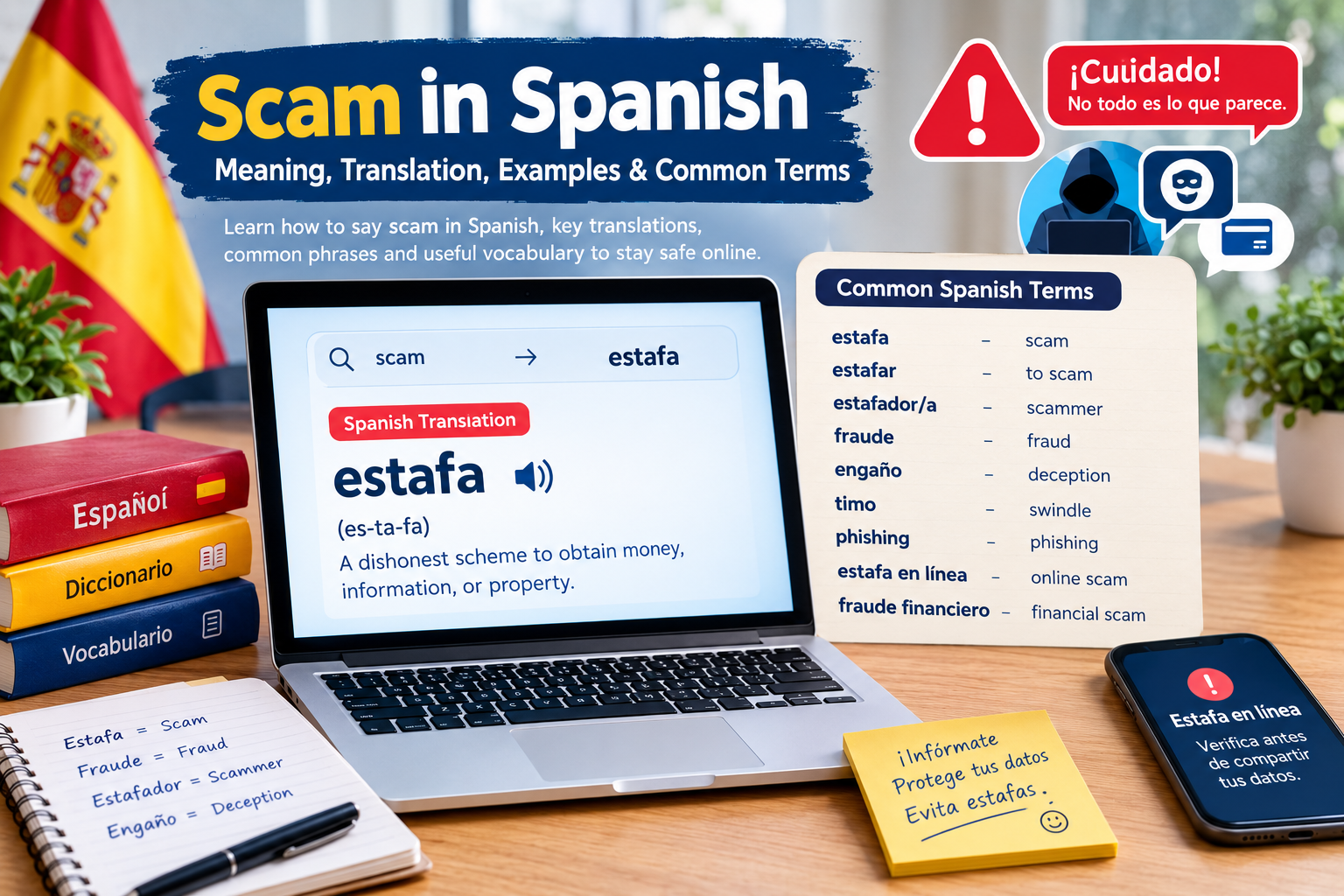
The most common translation of scam in Spanish is estafa.
The Spanish noun estafa generally refers to a dishonest scheme in which someone deceives another person to obtain money, property, information, or another benefit. The related verb estafar means “to scam,” “to defraud,” or “to swindle.”
For example:
- Es una estafa. — It is a scam.
- Me estafaron. — They scammed me.
- Ese sitio web es una estafa. — That website is a scam.
- Cuidado con las estafas. — Be careful with scams.
The exact translation can change depending on the situation. Fraude is commonly used for “fraud,” while engaño can describe deception or misleading behavior more generally.
Therefore, when someone asks what is scam in Spanish, “estafa” is usually the most direct answer.
How Do You Say Scam in Spanish?
If you are asking how do you say scam in Spanish, the simplest translation is:
Scam = Estafa
However, Spanish has several related terms that can be useful in different situations.
| English | Spanish |
|---|---|
| Scam | Estafa |
| To scam | Estafar |
| Scammer | Estafador / Estafadora |
| Fraud | Fraude |
| Fraudulent | Fraudulento / Fraudulenta |
| Deception | Engaño |
| Con artist | Estafador / Estafadora |
| Online scam | Estafa en línea |
| Internet scam | Estafa por Internet |
| Phishing | Phishing / Suplantación de identidad |
| Financial scam | Estafa financiera |
| Fake website | Sitio web falso |
These terms can help Spanish learners understand warnings about suspicious websites, financial schemes, and fraudulent messages.
What Is the Spanish Word for Scam?
The most common Spanish word for scam is estafa.
The word can be used in both everyday conversation and discussions about consumer fraud. Its related verb, estafar, describes the action of deceiving someone for financial or personal gain.
For example:
La oferta era una estafa.
The offer was a scam.
El vendedor me estafó.
The seller scammed me.
Hay muchas estafas en Internet.
There are many scams on the internet.
The plural form is estafas, meaning “scams.”
This distinction is useful because English uses “scam” as both a noun and a verb, while Spanish commonly uses different grammatical forms.
Scam Meaning in Spanish: Estafa, Fraude, and Engaño
Although estafa, fraude, and engaño can overlap, they are not always interchangeable.
Estafa
Estafa is generally the closest translation for a scam involving deception for personal or financial benefit.
Example:
Esta página es una estafa.
This page is a scam.
Fraude
Fraude translates more directly to “fraud.” It is often used in formal, legal, financial, or institutional contexts.
Example:
El banco detectó un posible fraude.
The bank detected possible fraud.
Engaño
Engaño means deception or deceit. It can be broader than a financial scam.
Example:
Todo fue un engaño.
It was all a deception.
Understanding these differences makes the scam in Spanish language easier to recognize in real conversations.
How to Say Scammer in Spanish
If you want to know how to say scammer in Spanish, common translations include:
- Estafador — male scammer
- Estafadora — female scammer
- Estafador/a — gender-inclusive written form
For example:
El estafador me envió un mensaje.
The scammer sent me a message.
La estafadora pidió mis datos bancarios.
The female scammer asked for my banking information.
The word estafador is formed from the verb estafar, meaning to scam or defraud.
Scammer Meaning in Spanish
The scammer meaning in Spanish is generally expressed with estafador or estafadora.
A scammer is someone who deliberately deceives people to obtain money, personal information, account access, products, or another benefit.
You may encounter phrases such as:
- un estafador en línea — an online scammer
- un estafador de Internet — an internet scammer
- un supuesto estafador — an alleged scammer
- una persona que estafa — a person who scams
When discussing a real person, it is important to distinguish between a confirmed scam and a suspicion. Spanish descriptions such as posible estafa can communicate that something appears suspicious without presenting an unverified accusation as established fact.
How to Say Online Scam in Spanish
If you are searching for how to say online scam in Spanish, one common phrase is:
Estafa en línea
You may also see:
Estafa por Internet
Both can describe an internet-based scam.
Examples include:
Cuidado con las estafas en línea.
Be careful with online scams.
Las estafas por Internet son cada vez más sofisticadas.
Internet scams are increasingly sophisticated.
Other useful expressions include:
- fraude en línea — online fraud
- fraude por Internet — internet fraud
- estafa digital — digital scam
- estafa en Internet — scam on the internet
These phrases are particularly useful when reading Spanish-language cybersecurity or consumer-protection information.
Internet Scam in Spanish
An internet scam in Spanish can be described as an estafa por Internet or estafa en Internet.
Internet scams can include fake shopping websites, phishing messages, fraudulent investment offers, fake job opportunities, impersonation schemes, and account takeover attempts.
For example:
Esta oferta podría ser una estafa por Internet.
This offer could be an internet scam.
No compartas tus datos personales con sitios web sospechosos.
Do not share your personal information with suspicious websites.
Learning these phrases can help Spanish speakers recognize warnings when browsing websites or using social media.
Fraud in Spanish
The most common fraud in Spanish translation is fraude.
Unlike “scam,” which is often used for deceptive schemes targeting individuals, “fraud” can have a broader and more formal meaning.
Examples include:
- fraude bancario — bank fraud
- fraude financiero — financial fraud
- fraude electrónico — electronic fraud
- fraude en línea — online fraud
- fraude de identidad — identity fraud
- fraude con tarjetas — card fraud
For example:
El banco investiga un posible fraude financiero.
The bank is investigating possible financial fraud.
Difference Between Scam and Fraud in Spanish
The difference between scam and fraud in Spanish is mostly related to context and usage.
Estafa often describes a specific deceptive scheme intended to trick someone.
Fraude can be broader and is frequently used in financial, legal, business, or institutional contexts.
For instance, a fake online store could be described as an estafa, while unauthorized manipulation of financial records could be discussed as fraude.
There can be significant overlap between the two terms, so the appropriate word depends on the situation.
Cheating in Spanish
The translation of cheating in Spanish depends heavily on context.
The English word “cheating” can mean:
- hacer trampa — to cheat in a game, test, or competition
- engañar — to deceive someone
- ser infiel — to be unfaithful in a relationship
This is important because “cheating” is not automatically translated as estafa.
For example:
Hacer trampa en un examen means cheating on an exam.
Meanwhile:
Engañar a alguien means deceiving someone.
If the deception specifically involves a financial scam, estafar is usually more appropriate.
Con in Spanish
The English word “con” can have several meanings, and the correct con in Spanish translation depends on context.
As a noun meaning a scam or swindle, it can often be translated as:
- estafa
- engaño
- timo
The Spanish word timo is also commonly associated with a trick or swindle.
For example:
Fue un timo.
It was a con/scam.
However, “con” can also mean “with” in Spanish. Therefore, context is essential when translating the word.
Con Artist in Spanish
A con artist in Spanish can commonly be described as:
- estafador
- estafadora
- timador
- timadora
The most appropriate word can depend on the region and context.
For example:
El estafador engañó a varias personas.
The con artist deceived several people.
El timador utilizó una identidad falsa.
The con artist used a false identity.
Both estafador and timador can describe someone who deceives others for personal gain.
Phishing in Spanish
Phishing is commonly used in Spanish as phishing, especially in technology and cybersecurity discussions.
Another expression is:
suplantación de identidad
This refers to impersonation or identity spoofing and is often used when explaining how attackers pretend to be legitimate organizations.
For example:
El correo electrónico era un intento de phishing.
The email was a phishing attempt.
El mensaje utilizaba la suplantación de identidad.
The message used identity impersonation.
A phishing attack may attempt to steal passwords, payment details, verification codes, or other sensitive information.
Financial Scam in Spanish
The common translation of financial scam in Spanish is:
Estafa financiera
You may also encounter:
fraude financiero
Both expressions are useful, although estafa financiera emphasizes a deceptive scheme while fraude financiero can sound more formal.
Examples include fake investment opportunities, fraudulent loan offers, fake financial services, and impersonation of banks or financial institutions.
A useful warning is:
Cuidado con las estafas financieras en línea.
Be careful with online financial scams.
Common Scam Phrases in Spanish
Learning common scam phrases in Spanish can help identify suspicious messages.
Here are some examples:
“Has ganado un premio”
This means:
You have won a prize.
Unexpected prize notifications can be suspicious, especially when they request payment or personal information before releasing the supposed reward.
“Debes pagar ahora”
This means:
You must pay now.
Urgent payment demands are commonly associated with fraudulent schemes.
“Confirma tus datos”
This means:
Confirm your information.
Be cautious when an unexpected message asks you to submit passwords, banking information, or security codes.
“Tu cuenta será bloqueada”
This means:
Your account will be blocked.
Scammers may use threats of account closure to pressure people into clicking links or sharing sensitive information.
“Oferta por tiempo limitado”
This means:
Limited-time offer.
A legitimate limited-time offer can exist, but extreme urgency combined with unusual payment requests deserves additional verification.
How to Identify a Scam in Spanish
Learning how to identify a scam in Spanish requires understanding both language and context.
Watch for messages that create unnecessary urgency, request sensitive information, promise unrealistic rewards, or direct you toward unfamiliar websites.
Common warning signs include:
- Unexpected requests for money
- Requests for passwords or verification codes
- Unusual payment methods
- Suspicious links
- Fake customer-support messages
- Unrealistic investment returns
- Pressure to act immediately
- Poorly written or inconsistent messages
- Requests for gift cards or cryptocurrency
- Offers that seem unusually good
A scam warning in Spanish may contain words such as:
estafa, fraude, peligro, cuidado, phishing, or sitio sospechoso.
Understanding these terms can make online safety information easier to follow.
How to Say Fraud in Spanish
If you are searching for how to say fraud in Spanish, the answer is:
Fraud = Fraude
Related terms include:
- Fraudulent = Fraudulento / Fraudulenta
- Fraudster = Defraudador / Defraudadora
- Financial fraud = Fraude financiero
- Online fraud = Fraude en línea
- Identity fraud = Fraude de identidad
Example:
El sitio está relacionado con un posible fraude.
The website is associated with possible fraud.
Common Spanish Words Used for Scams
Understanding common Spanish words used for scams can improve your ability to read warnings and safety information.
| Spanish Word | English Meaning |
|---|---|
| Estafa | Scam |
| Estafar | To scam |
| Estafador | Scammer |
| Fraude | Fraud |
| Fraudulento | Fraudulent |
| Engaño | Deception |
| Engañar | To deceive |
| Timo | Swindle / scam |
| Timador | Con artist / swindler |
| Phishing | Phishing |
| Suplantación | Impersonation |
| Sospechoso | Suspicious |
| Falso | Fake |
| Seguridad | Security |
| Advertencia | Warning |
These words frequently appear in discussions about online security, consumer protection, and fraudulent activity.
Scam Warning in Spanish
A scam warning in Spanish may use simple expressions such as:
Cuidado con esta estafa.
Be careful with this scam.
No compartas información personal.
Do not share personal information.
No hagas clic en enlaces sospechosos.
Do not click suspicious links.
Verifica el sitio web antes de realizar un pago.
Verify the website before making a payment.
No envíes dinero a personas desconocidas.
Do not send money to strangers.
These phrases are useful for Spanish-language websites, consumer education, cybersecurity awareness, and everyday communication.
Frequently Asked Questions About Scam in Spanish
What does scam mean in Spanish?
The most common translation of scam in Spanish is estafa. Depending on context, fraude, engaño, or timo may also be appropriate.
How do you say scam in Spanish?
You can say estafa for the noun “scam” and estafar for the verb “to scam.”
How do you say scammer in Spanish?
“Scammer” is commonly translated as estafador for a male person and estafadora for a female person.
What is the Spanish word for scam?
The most common Spanish word for scam is estafa.
How do you say online scam in Spanish?
“Online scam” can be translated as estafa en línea, estafa por Internet, or estafa en Internet.
What is fraud in Spanish?
“Fraud” translates to fraude.
Is phishing translated into Spanish?
The term phishing is widely used in Spanish. Suplantación de identidad can also describe aspects of phishing involving impersonation.
What does estafa mean?
Estafa means scam, swindle, or fraudulent scheme. It generally refers to deception intended to obtain money, property, information, or another benefit.
Final Thoughts on Scam in Spanish
Understanding scam in Spanish is useful for language learners, travelers, online shoppers, and anyone who wants to recognize fraud-related information in Spanish.
The most important translation to remember is estafa, while fraude means fraud, estafador means scammer, and estafar means to scam. Other useful words include engaño, timo, phishing, and suplantación de identidad.
Learning these terms can make Spanish-language scam warnings easier to understand. It can also help people recognize suspicious messages, fake websites, unusual payment requests, and other common forms of online fraud.
Whether you are searching for the Spanish translation for scam, learning how to say scammer in Spanish, or trying to understand common scam phrases in Spanish, knowing the vocabulary provides an important foundation for safer communication online.