
How Does Keyword Tool Work? A Complete Guide to Keyword Research

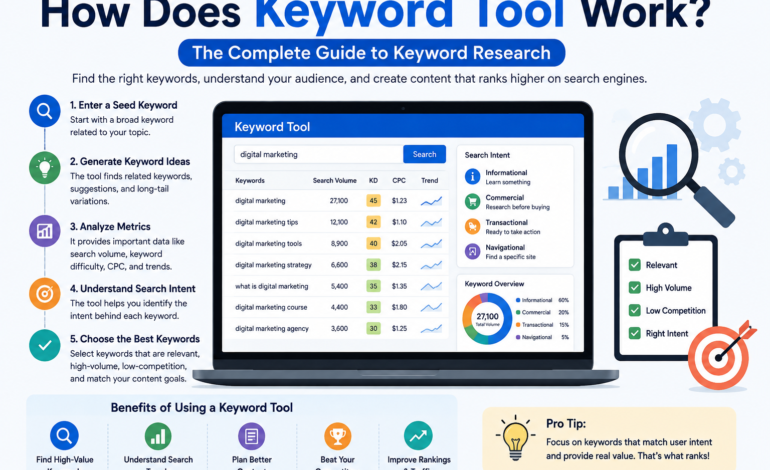
Keyword research is one of the foundations of successful search engine optimization. Before creating a blog post, product page, landing page, or any other search-focused content, it is important to understand what people are actually searching for. This is where a keyword tool becomes useful. It helps transform broad topics into specific search terms that can be evaluated according to search demand, competition, relevance, and intent.
A keyword research platform does more than simply provide a list of words. Modern tools can generate keyword ideas, discover long-tail queries, estimate search volume, evaluate keyword difficulty, identify related searches, analyze trends, and provide information that helps content creators understand the search landscape. When these insights are interpreted correctly, they can make content planning more focused and useful.
Understanding how a keyword tool works is important because keyword data should not be treated as a collection of numbers. Search volume, competition, relevance, and intent all provide different pieces of information. A strong SEO strategy combines these signals rather than selecting keywords based only on the highest search volume.
This guide explains how keyword research tools work, where their keyword suggestions come from, how search volume and competition are estimated, how search intent affects keyword selection, and how businesses and publishers can use keyword data to build useful content that satisfies searchers.
What Is a Keyword Tool?
A keyword tool is an SEO research platform designed to help users discover and evaluate the search terms people use on search engines. Depending on the platform, it may provide keyword suggestions, estimated monthly search volume, keyword difficulty, cost-per-click data, trends, competition metrics, related terms, and other information.
For example, someone planning content about website security may start with the broad topic “website security.” A keyword research tool can expand that topic into related searches such as website security tips, how to secure a website, website security checklist, common website security threats, and other variations.
The purpose is not simply to find as many keywords as possible. The goal is to identify search terms that are relevant to the audience and appropriate for the specific content being created.
A good keyword research process therefore considers three major questions:
- What are people searching for?
- Why are they searching for it?
- How difficult is it to compete for that search?
Answering these questions helps turn keyword research into a practical content strategy.
How Does Worked?
A keyword tool generally works by taking a seed keyword or topic and using search-related data sources, databases, algorithms, and keyword relationships to generate potential search terms. The exact technology differs from one platform to another, so the available metrics and results can vary.
The process usually begins when a user enters a seed keyword. The tool then searches its database or connected data sources for related phrases and variations. Depending on the platform, the results may include autocomplete-style suggestions, related queries, historical search information, advertising data, or keyword databases created from large-scale search behavior.
After generating suggestions, the platform may attach different metrics to each keyword. These metrics can include estimated search volume, keyword difficulty, competition, cost per click, trend information, and traffic potential.
The user can then filter and organize the results to identify the most relevant opportunities.
A simplified keyword research process looks like this:
Seed topic → Keyword suggestions → Search data → Keyword metrics → Intent analysis → Filtering → Content planning
This process allows a broad idea to become a structured list of potential search queries.
Step 1: Entering a Seed Keyword
The first step usually involves entering a seed keyword. A seed keyword is a broad word or phrase that represents the subject being researched.
For example, a website about technology might enter:
- artificial intelligence
- cloud computing
- cybersecurity
- SEO
- web hosting
- digital marketing
The tool uses this initial term as a starting point for discovering related queries.
A seed keyword should be closely connected to the website’s topic or the content being planned. Entering unrelated terms may produce large amounts of data, but much of that information will not be useful.
Using several relevant seed topics can also reveal different parts of a search market. For example, an SEO website might research “keyword research,” “technical SEO,” “link building,” and “content optimization” separately instead of relying on one broad term.
Step 2: Generating Keyword Suggestions
Once a seed term is entered, the platform generates related keyword ideas. These suggestions can come in several forms.
Some tools identify variations of the original query, while others discover related topics, questions, phrases, and long-tail searches. Search suggestions may also include different word orders, modifiers, questions, locations, comparisons, and specific use cases.
For example, a seed keyword such as “email marketing” might produce:
- email marketing strategy
- email marketing for beginners
- how does email marketing work
- email marketing examples
- email marketing tools
- email marketing automation
- best email marketing practices
These terms are not equally valuable for every website. Their usefulness depends on relevance, search intent, competition, and the site’s ability to provide a strong answer.
Keyword suggestions therefore represent the discovery stage rather than the final keyword selection stage.
Step 3: Using Search Data
After generating keyword ideas, a keyword research platform may provide estimated data for each term. One of the most commonly displayed metrics is search volume.
Search volume attempts to estimate how frequently a particular keyword is searched during a specified period, often on a monthly basis. However, it should be treated as an estimate rather than an exact count.
Search behavior changes over time because of trends, seasons, news, product launches, consumer behavior, and other factors. Some keywords receive consistent interest throughout the year, while others experience significant fluctuations.
For example, searches related to holiday shopping may increase toward the end of the year. Searches related to a newly released technology product may increase shortly after launch and decline later.
Because of these variations, search volume is most useful when combined with other signals.
What Is Keyword Search Volume?
Keyword search volume represents the estimated number of searches associated with a search term over a particular period.
High-volume keywords may appear attractive because they potentially represent a large audience. However, high volume often comes with stronger competition. A website may receive better results by targeting a relevant keyword with moderate search demand and realistic competition.
Consider the difference between a broad keyword such as “laptops” and a more specific query such as “best laptops for graphic design students.”
The first query may have significantly higher search demand, but it is extremely broad. The second query communicates a much clearer need. Content designed specifically for that audience may have a better chance of satisfying the searcher.
Search volume should therefore answer one question:
Is there meaningful demand for this topic?
It should not be the only factor used to decide whether a keyword is worth targeting.
Step 4: Measuring Keyword Difficulty
Keyword difficulty is another common metric provided by SEO platforms. It attempts to estimate how difficult it may be to rank organically for a particular search term.
Different platforms calculate this score differently. Some primarily evaluate the strength of websites and backlinks associated with ranking pages, while others use additional signals.
A keyword with a high difficulty score may have many strong competitors already ranking for it. A newer or less authoritative website may therefore need considerable time and resources to compete.
Lower-difficulty keywords can sometimes provide more accessible opportunities, particularly for websites that are still developing their organic visibility.
However, low difficulty does not automatically mean a keyword is valuable. A keyword can have low competition but little relevance or search demand. The best opportunities usually balance:
Relevance + Search Demand + Competition + Search Intent
This balance is more useful than chasing a specific difficulty score.
Step 5: Understanding Search Intent
Search intent refers to the reason behind a user’s search.
Two keywords can discuss the same subject but represent completely different intentions. Understanding this difference is essential when selecting keywords and creating content.
The main categories of search intent include:
Informational Intent
The user wants to learn something.
Examples include:
- how does keyword research work
- what is technical SEO
- how does cloud storage work
- benefits of content marketing
Informational keywords are often suitable for guides, tutorials, explainers, educational articles, and how-to content.
Navigational Intent
The user wants to find a particular website, company, page, or platform.
Examples include:
- Google Search Console
- YouTube login
- Semrush dashboard
These searches usually indicate that the user already knows where they want to go.
Commercial Investigation
The user is researching options before making a decision.
Examples include:
- best keyword research tools
- SEO software comparison
- keyword tool alternatives
- best hosting for WordPress
Comparison articles, reviews, buying guides, and detailed evaluations can serve this type of intent.
Transactional Intent
The user is ready to complete an action, often involving a purchase or signup.
Examples include:
- buy SEO software
- keyword research subscription
- website hosting plans
- SEO tool pricing
Understanding intent prevents a common SEO mistake: creating content that technically targets a keyword but does not satisfy what searchers actually want.
Why Long-Tail Keywords Matter
Long-tail keywords are more specific search phrases, usually containing several words. They often have lower individual search volume than broad terms, but they can provide valuable insights into what users specifically need.
For example:
Broad:
“SEO”
More specific:
“SEO keyword research for small business websites”
Highly specific:
“how to find low competition SEO keywords for a new website”
The longer query communicates a more precise problem.
Long-tail searches can be particularly useful for informational content because they allow publishers to address specific questions and situations. They can also help smaller websites build topical relevance before attempting to compete for highly competitive broad terms.
A keyword tool can uncover these phrases by analyzing related searches, question formats, modifiers, and keyword variations.
How Keyword Tools Find Related Keywords
Keyword research platforms may use several methods to discover related terms. One common approach is analyzing relationships between search phrases.
Related keywords can include:
- synonyms
- variations
- questions
- related concepts
- modifiers
- comparisons
- problem-based searches
- audience-specific queries
- location-specific searches
For example, a page about “website speed” might naturally connect with terms such as:
- page load time
- website performance
- Core Web Vitals
- site speed optimization
- image optimization
- browser caching
- server response time
These terms help search engines and readers understand the broader subject covered by a page.
Semantic optimization does not mean inserting every related keyword into an article. Instead, related concepts should appear naturally where they improve the explanation.
Keyword Clustering and Topic Grouping
Keyword clustering involves grouping closely related search terms according to their meaning or search intent.
Suppose a keyword tool generates hundreds of terms related to “content marketing.” Instead of creating one page for every slightly different phrase, related keywords can be grouped into broader topic clusters.
A possible structure could be:
| Main Topic | Supporting Topics |
|---|---|
| Content Marketing | strategy, planning, examples |
| Content Strategy | research, audience, goals |
| Content Creation | writing, design, video |
| Content Distribution | social media, email, promotion |
| Content Measurement | traffic, engagement, conversions |
This approach helps prevent unnecessary content duplication and creates a more organized website structure.
Keyword clustering is especially useful for large websites because it can help identify which terms should be covered together and which deserve separate pages.
Keyword Competition vs. Search Volume
Search volume and competition are related but different metrics.
A keyword may have:
- High volume and high competition
- High volume and moderate competition
- Low volume and low competition
- Moderate volume and low competition
The ideal opportunity depends on the website.
For an established website with strong authority, competitive keywords may be realistic. For a newer website, specific lower-competition queries may provide a more practical starting point.
The important principle is to avoid selecting keywords solely because they have the largest number next to them.
A keyword with 500 monthly searches and strong relevance can potentially be more valuable than a keyword with 50,000 searches where the search intent does not match the website.
How Competitor Keyword Research Works
Many keyword platforms also support competitor analysis. This process involves examining the search terms for which competing websites appear to receive organic visibility.
Competitor keyword research can reveal:
- topics competitors cover
- keywords they rank for
- content gaps
- related subtopics
- high-value pages
- potential long-tail opportunities
The objective should not be to copy competitor content. Instead, competitor research can identify areas where an audience’s needs may not be fully addressed.
For example, if several competing pages discuss the basics of a topic but none provides a detailed comparison table, practical examples, or troubleshooting section, those gaps may represent opportunities for more useful content.
Keyword Trends and Seasonality
Some keywords change significantly in popularity over time. A keyword tool may provide historical trend information to help identify these patterns.
Trend data can reveal whether a keyword is:
- consistently popular
- growing
- declining
- seasonal
- affected by temporary events
This information is useful for content planning.
For example, a retailer might notice that searches for certain products increase several weeks before a major shopping season. Publishing useful content before demand peaks can provide more time for search engines to discover, crawl, and rank the page.
Trend information is therefore particularly valuable for editorial calendars and seasonal SEO campaigns.
What Is Keyword Relevance?
Keyword relevance describes how closely a search term matches the subject, audience, and purpose of a webpage.
Relevance should always be prioritized over raw search volume.
Imagine a technology website has a page about cloud security. A keyword with millions of searches might look attractive, but if it relates primarily to cloud gaming rather than cloud security, targeting it would not make sense.
Relevant keywords help attract visitors who are more likely to find the page useful.
A useful relevance test is:
If someone searches this keyword, would this page completely or substantially answer their question?
If the answer is no, the keyword may not belong on that page.
Keyword Difficulty Is Not a Guarantee
Keyword difficulty scores are useful for comparison, but they should not be treated as guarantees.
A low-difficulty keyword can still be difficult to rank for if the search results are dominated by highly relevant and authoritative websites. Similarly, a higher-difficulty keyword may become achievable when a website has strong topical authority, quality content, valuable backlinks, and a well-structured site.
The actual search results should therefore be examined alongside the tool’s difficulty score.
Look at:
- the type of pages ranking
- content quality
- website authority
- backlinks
- topical relevance
- freshness
- search intent
- content depth
The search engine results page provides context that a single difficulty number cannot provide.
How to Choose the Right Keyword
Selecting a keyword should involve several evaluation criteria.
1. Relevance
The keyword should directly relate to the page’s subject.
2. Search Intent
The content should match what users expect to find.
3. Search Demand
There should be sufficient interest to justify creating the content.
4. Competition
The keyword should be realistically achievable based on the website’s current strength.
5. Business or Content Value
The keyword should contribute to the website’s broader goals, whether that means education, visibility, leads, sales, or brand awareness.
6. Content Opportunity
There should be a meaningful way to create something useful and distinctive around the topic.
When these factors align, keyword selection becomes much more strategic.
How Keyword Tools Help With Content Planning
Keyword research can influence the entire content creation process.
A keyword database can help determine:
- what topics to cover
- which questions to answer
- how to structure headings
- which subtopics deserve explanation
- which terms should be grouped
- what content gaps exist
- which pages should be created first
For example, a broad topic may produce dozens of related questions. These questions can become H2 or H3 sections within a comprehensive guide when they share the same intent.
This creates content that is organized around user needs rather than simply around keyword repetition.
Keyword Tools and On-Page SEO
Keyword research is closely connected to on-page optimization.
Important areas include:
- SEO title
- main heading
- introduction
- subheadings
- body content
- image alt text when relevant
- URL
- internal links
- meta description
However, keywords should be used naturally.
Search engines have become much better at understanding topics, entities, context, and relationships between concepts. Repeating an exact phrase excessively can make content difficult to read and may create an unnatural experience.
The stronger approach is to use the main topic naturally while covering relevant concepts comprehensively.
Keyword Stuffing and Why It Should Be Avoided
Keyword stuffing occurs when a keyword is inserted excessively or unnaturally in an attempt to manipulate search rankings.
For example, repeatedly placing the same phrase in every paragraph can reduce readability and make the article appear artificial.
A better strategy is to use:
- natural keyword variations
- related terms
- synonyms
- descriptive phrases
- questions
- supporting concepts
The goal is to make the content easy for humans to understand while clearly communicating its subject to search engines.
SEO should support good content rather than replace it.
How to Use Keyword Tool Data Correctly
Keyword data becomes useful when it supports decision-making rather than dictating every sentence.
A practical workflow is:
Start with a topic → Generate ideas → Remove irrelevant terms → Analyze intent → Review competition → Group related terms → Build content structure → Write naturally → Optimize the final page
This workflow helps prevent a common mistake in keyword research: collecting hundreds of keywords without knowing what to do with them.
A smaller list of highly relevant keywords can be more valuable than a huge database of unrelated suggestions.
Common Keyword Research Mistakes
Choosing Only High-Volume Keywords
High volume does not automatically mean high value. Broad keywords can be extremely competitive and may have unclear intent.
Ignoring Search Intent
A page can target the right words but still fail if it provides the wrong type of information.
Focusing Too Much on Keyword Difficulty
Difficulty is an estimate, not a ranking guarantee. Search-result analysis remains important.
Creating One Page for Every Keyword Variation
Very similar keywords may belong on one comprehensive page rather than separate pages.
Ignoring Long-Tail Searches
Specific queries often reveal valuable problems and questions that broad keywords cannot communicate.
Overusing Exact-Match Keywords
Natural language and semantic relevance are more important than repeating an exact phrase.
Using Outdated Keyword Data
Search behavior changes. Trends, competitors, and user interests should be reviewed regularly.
Keyword Research Metrics at a Glance
| Metric | What It Indicates | How to Use It |
|---|---|---|
| Search Volume | Estimated search demand | Understand potential interest |
| Keyword Difficulty | Estimated ranking competition | Evaluate competitiveness |
| CPC | Advertising value | Understand commercial interest |
| Trends | Changes in demand | Identify growth or seasonality |
| Search Intent | User’s purpose | Match content format |
| Relevance | Topic relationship | Remove unrelated terms |
| SERP Competition | Strength of ranking pages | Evaluate real-world difficulty |
| Long-Tail Potential | Specific search opportunities | Find targeted queries |
No individual metric should determine the final decision. The strongest keyword strategy combines multiple signals.
Free vs. Paid Keyword Tools
Keyword research platforms are available in both free and paid forms.
Free tools can be useful for discovering basic keyword ideas, questions, autocomplete suggestions, and related searches. They are often sufficient for beginners who are learning how keyword research works.
Paid platforms generally provide larger databases and more advanced features, such as:
- detailed keyword difficulty metrics
- historical data
- competitor analysis
- rank tracking
- keyword clustering
- content analysis
- advanced filtering
- broader international databases
The right option depends on the size of the website, SEO goals, budget, and required level of research.
A sophisticated tool is not automatically better if the underlying strategy is poor. Understanding search intent and content quality remains essential regardless of the platform being used.
How to Build a Keyword Research Workflow
An effective workflow can be divided into several stages.
Stage 1: Define the Topic
Start by identifying the main subject and audience.
Stage 2: Generate Keyword Ideas
Use one or more seed keywords to discover variations, questions, and related topics.
Stage 3: Filter the Results
Remove keywords that are irrelevant, overly broad, duplicated, or unrelated to the website’s purpose.
Stage 4: Analyze Intent
Determine whether each keyword is informational, navigational, commercial, or transactional.
Stage 5: Evaluate Competition
Review keyword difficulty and, more importantly, examine the actual search results.
Stage 6: Group Keywords
Organize closely related phrases into topic clusters.
Stage 7: Create the Content Brief
Decide the primary topic, supporting sections, questions, examples, and content format.
Stage 8: Optimize Naturally
Use relevant terminology throughout the content without forcing keywords into sentences.
Stage 9: Monitor Performance
After publication, monitor organic visibility, rankings, clicks, impressions, and user engagement.
This process turns keyword research into an ongoing SEO system instead of a one-time task.
How Keyword Research Supports Topical Authority
Topical authority develops when a website consistently provides useful, comprehensive information around a subject.
Keyword research can help identify the different questions and subtopics within a broader subject. These insights can then be organized into pillar pages and supporting articles.
For example, a website focused on SEO might create a central guide about keyword research and supporting content about:
- long-tail keywords
- search intent
- keyword difficulty
- competitor research
- keyword clustering
- content gaps
- keyword mapping
Internal links can connect related pages and help users navigate the subject.
The objective is not to publish content simply because a keyword exists. Each page should provide a meaningful resource that serves a distinct search need.
Keyword Mapping
Keyword mapping is the process of assigning target search terms to specific pages on a website.
A simple keyword map might look like this:
| Page | Primary Topic | Supporting Terms |
|---|---|---|
| Homepage | SEO Services | SEO strategy, organic search |
| Guide | Keyword Research | keyword tool, search volume |
| Article | Long-Tail Keywords | specific keywords, low competition |
| Article | Search Intent | informational intent, commercial intent |
| Article | Keyword Difficulty | SEO competition, ranking difficulty |
Keyword mapping reduces the risk of multiple pages competing for exactly the same search intent.
It also creates a clearer relationship between keywords and website architecture.
How to Evaluate Keyword Opportunities Manually
Keyword tools provide useful data, but manual evaluation can improve decision-making.
Search the keyword and examine the results.
Ask:
- What type of pages are ranking?
- Are they guides, product pages, category pages, or videos?
- Do they fully answer the query?
- Are the results recent?
- Are authoritative domains dominating?
- Are there obvious content gaps?
- Does the existing content match the search intent?
If the current results do not adequately satisfy the query, there may be an opportunity to create a more useful resource.
This manual review is especially important for competitive keywords.
What Makes a Keyword Valuable?
A valuable keyword is not necessarily the one with the highest search volume.
Its value can come from a combination of:
Relevance + Intent + Demand + Achievability + Audience Value
For an informational website, a question-based keyword may be highly valuable because it attracts users looking for detailed explanations.
For a commercial website, a comparison keyword may be more valuable because the user is closer to making a decision.
Therefore, keyword value should always be evaluated in context.
Frequently Asked Questions
How does a worked?
A keyword tool generally starts with a seed term and generates related search queries using keyword databases, search-related data, algorithms, and other information sources. It may then provide metrics such as search volume, difficulty, competition, trends, and related keywords to help users evaluate opportunities.
Are keyword tool search volumes exact?
No. Search volume figures are generally estimates. Different platforms may produce different numbers because they use different databases, methodologies, geographic settings, and calculation models.
What is the best keyword to target?
The best keyword is usually one that closely matches the content, has meaningful search demand, aligns with search intent, and has competition that is realistic for the website.
Are low-competition keywords always better?
Not necessarily. Low competition is useful, but a keyword must also be relevant and have enough search demand to justify targeting it.
Why are long-tail keywords important?
Long-tail keywords are more specific and often communicate a clearer user need. They can help content address focused questions and may be more accessible than highly competitive broad keywords.
Should every keyword have its own page?
No. Closely related keywords with the same search intent can often be addressed effectively on one comprehensive page. Creating separate pages for every minor variation can lead to unnecessary duplication.
How often should keyword research be performed?
Keyword research should be revisited periodically, especially when launching new content, entering a new market, updating an established website, or responding to major changes in search behavior.
Can keyword tools guarantee Google rankings?
No. No keyword tool can guarantee organic rankings. Ranking depends on many factors, including content quality, relevance, search intent, competition, website architecture, authority, links, technical performance, and other search-system signals.
Final Thoughts
Understanding how a keyword tool works makes SEO keyword research much more effective. These platforms provide a structured way to discover search queries, evaluate demand, understand competition, identify related topics, and organize content opportunities.
The most important lesson is that keyword research should not be reduced to finding the biggest search volume or the lowest difficulty score. Effective research combines quantitative data with qualitative analysis. Search intent, relevance, content quality, competition, and audience needs all matter when deciding which topics deserve attention.
A keyword tool is therefore best viewed as a research and planning resource. It can reveal what people may be searching for, but the final responsibility is to create content that genuinely answers those searches.
When keyword data is combined with strong topical coverage, useful information, logical website architecture, natural language, and consistent content improvement, it becomes a powerful part of a long-term SEO strategy. The ultimate objective is not simply to attract a search visit. It is to make the resulting page useful enough that the visitor finds the information they were looking for and has a reason to trust the website as a reliable source.