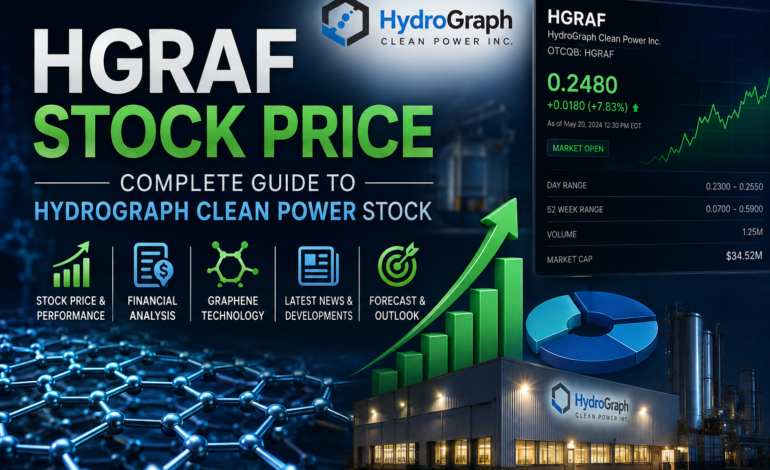
HGRAF (Ticker): Complete Guide to HydroGraph Clean Power, Stock, Graphene Technology, and Outlook

Introduction
HGRAF (Ticker) is associated with HydroGraph Clean Power Inc., an advanced materials company focused on graphene production and related nanomaterial technologies. The company has attracted interest from investors and researchers because graphene is being explored for applications in energy storage, coatings, composites, lubricants, polymers, construction, automotive products, aerospace materials, and other industrial markets.
However, understanding HGRAF requires more than looking at a stock quote. The underlying company operates in an emerging technology sector where commercial adoption, manufacturing capacity, customer demand, financing, and technological development can have a major influence on the business.
For this reason, anyone researching the HGRAF ticker, HydroGraph Clean Power stock, or the broader graphene industry should examine the company from several different angles. Its technology provides one part of the story, while commercialization and financial execution provide another.
This guide explains what HGRAF represents, what HydroGraph Clean Power does, how its graphene technology fits into the market, which factors can influence the stock, what growth opportunities exist, and which risks investors should understand.
What Is HGRAF (Ticker)?
HGRAF (Ticker) is the OTCQB trading symbol associated with HydroGraph Clean Power Inc. The company operates in the advanced materials industry and focuses on graphene and related nanomaterials.
HydroGraph also has a Canadian Securities Exchange listing under the symbol HG. Therefore, investors may see either HGRAF or HG when searching for information about the company, depending on the exchange and financial platform being used.
The company’s business is centered on advanced materials rather than conventional electricity generation. Its name can sometimes create confusion because the word “Power” may suggest a traditional energy company. In reality, HydroGraph’s core business strategy is closely connected to graphene production and commercialization.
Understanding this distinction is important when conducting an HGRAF stock analysis because the factors affecting an advanced-materials company can be very different from those influencing utilities, oil companies, or conventional power producers.
HydroGraph Clean Power Company Overview
HydroGraph Clean Power was established in 2017 and focuses on the production and commercialization of graphene and other nanomaterials.
The company has developed its business around a patented detonation-based graphene production process associated with research from Kansas State University. Its production technology is known as the Hyperion System.
HydroGraph describes the Hyperion System as a compact and scalable technology designed to produce high-quality graphene. The company has positioned this production platform as a potential solution for customers across multiple industries.
The broader objective is to move graphene from specialized research environments toward practical commercial applications.
That objective is important because the value of a graphene company ultimately depends on whether its technology can be manufactured consistently, supplied at competitive economics, and adopted by customers.
What Is Graphene?
Graphene is a carbon material consisting of a single layer of carbon atoms arranged in a hexagonal structure. Despite its extremely thin structure, graphene has several properties that make it interesting for industrial and technological applications.
These properties can include:
- High strength
- Electrical conductivity
- Thermal conductivity
- Low weight
- Large surface area
- Chemical resistance
- Mechanical flexibility
- Potential barrier properties
Because of these characteristics, researchers and manufacturers have investigated graphene for a wide range of applications.
The potential uses of graphene are one reason the advanced materials market has received attention from investors. However, technical potential should not be confused with guaranteed commercial success.
A graphene product must provide a measurable benefit at an acceptable cost before manufacturers are likely to adopt it on a large scale.
How HydroGraph’s Hyperion System Works
The Hyperion System is central to HydroGraph’s business strategy.
The company describes the system as a scalable platform for graphene production. Its technology uses a detonation-based process to produce graphene and hydrogen, with the resulting material intended for different industrial applications.
One potential advantage of a scalable production system is that manufacturing capacity can be increased as customer demand develops.
HydroGraph has also emphasized the ability to produce graphene with specific characteristics for different applications. This can be important because different customers may require different material properties depending on how graphene will be incorporated into their products.
For example, a battery-related application can have different requirements from a coating, lubricant, polymer, or composite application.
This flexibility can create opportunities across multiple markets, but it also means that each application needs appropriate testing, customer validation, and commercial development.
HGRAF (Ticker) and the Graphene Market
The broader graphene market provides the commercial environment in which HydroGraph operates.
Graphene is being investigated for applications that could improve the performance of existing materials or enable new product designs. The potential market includes both established industrial sectors and emerging technologies.
Some of the most frequently discussed application areas include:
Energy Storage
Graphene has been studied for batteries, supercapacitors, and other energy-storage technologies. Researchers are interested in its electrical and thermal characteristics and how they may complement other battery materials.
The commercial opportunity depends on whether graphene can provide sufficient performance improvements without making the resulting product uneconomical.
Automotive Materials
Automotive manufacturers continuously seek materials that can reduce weight, improve durability, or increase efficiency.
Graphene could potentially be incorporated into composites, coatings, lubricants, batteries, and other vehicle components.
Aerospace
Aerospace applications require materials that can provide strength and durability while controlling weight. Graphene-enhanced composites and coatings are therefore areas of ongoing interest.
Construction
Graphene may also be incorporated into concrete and other construction materials. Potential improvements in durability, strength, or material efficiency could make these applications attractive if they can be produced economically.
Industrial Coatings
Graphene can be investigated for coatings where conductivity, protection, durability, or resistance are important.
Lubricants
Another potential application involves lubricants and friction-reduction technologies. Graphene’s structure has made it an area of research for reducing wear and improving lubrication performance.
The diversity of these applications gives HydroGraph several potential avenues for growth. At the same time, each market has different technical and commercial requirements.
HGRAF Stock Price: What Influences It?
The HGRAF stock price can change because of both company-specific developments and broader market conditions.
Investors should avoid judging the company based only on whether the share price is rising or falling on a particular day.
Several factors can influence the market price.
Company Announcements
News involving production, partnerships, financing, customers, facilities, or technology can affect investor expectations.
Trading Volume
Trading volume is particularly important for smaller publicly traded companies. Limited liquidity can contribute to larger price movements.
Financial Results
Revenue, expenses, cash flow, assets, liabilities, and financing requirements can influence how investors value the company.
Commercial Progress
Evidence that customers are moving from testing to actual commercial orders can be an important signal of business development.
Market Sentiment
Investor sentiment toward graphene, advanced materials, small-cap companies, and emerging technologies can influence the stock independently of short-term operational changes.
How to Analyze HGRAF Stock
A useful HGRAF stock analysis should not depend on one metric. Instead, investors can divide their research into several categories.
| Category | Key Questions |
|---|---|
| Technology | Does the production technology provide a meaningful advantage? |
| Production | Can manufacturing scale efficiently? |
| Customers | Are customers moving toward commercial purchases? |
| Revenue | Is the business generating sustainable sales? |
| Cash | Does the company have sufficient capital? |
| Financing | Will additional funding be required? |
| Competition | How does HydroGraph compare with alternatives? |
| Market | Is graphene adoption increasing? |
| Share Structure | Could future financing cause dilution? |
This framework creates a more balanced understanding of the company.
A low share price does not automatically indicate an undervalued business, just as a higher share price does not automatically mean that a company is overvalued.
Market capitalization, revenue, cash requirements, outstanding shares, and future growth potential should all be considered together.
HydroGraph Clean Power Business Model
HydroGraph’s business model is centered around graphene production and the development of commercial applications for its material.
The company can potentially generate value by supplying graphene to customers that use it as an ingredient or functional material in their own products.
This creates a business model that is somewhat different from selling a finished consumer product directly to the public.
Instead, HydroGraph’s success depends heavily on industrial customers determining that graphene adds enough value to justify incorporating it into their manufacturing processes.
Customer adoption can therefore be influenced by several factors:
- Material performance
- Consistency
- Production cost
- Supply reliability
- Technical support
- Compatibility with existing manufacturing
- Regulatory requirements
- Economic benefit
If graphene provides a clear advantage while remaining commercially competitive, customer adoption may become easier.
Commercialization: The Key Factor for HGRAF
Technology development is only one part of the HydroGraph story.
The more important long-term question is whether the company’s technology can produce sustainable commercial revenue.
There is a major difference between:
Research interest → Product testing → Customer evaluation → Commercial order → Repeat sales
Each stage represents a different level of business maturity.
A research partnership or testing arrangement may indicate interest, but recurring orders provide stronger evidence that a product has achieved commercial acceptance.
For this reason, investors researching HydroGraph Clean Power stock should pay attention to actual revenue development and customer activity rather than focusing only on the number of potential applications.
Production Capacity and Expansion
Manufacturing capacity is another important part of the company’s future.
HydroGraph has discussed expanding production capabilities, including its Texas facility and plans associated with increased graphene production.
Additional capacity could provide several advantages if demand develops.
First, it could allow the company to serve larger customers. Second, it could increase the number of applications that can be pursued simultaneously. Third, greater production volume could potentially improve manufacturing economics.
However, production expansion also introduces additional costs and operational challenges.
A larger facility requires capital, equipment, employees, quality control, logistics, and sufficient customer demand.
Therefore, investors should not look at capacity expansion in isolation. The important question is whether the additional capacity can ultimately generate profitable commercial activity.
HGRAF Stock Forecast: What Could Happen Next?
A reliable HGRAF stock forecast cannot be reduced to one guaranteed future price.
Emerging technology stocks can respond quickly to changes in expectations, and future performance depends on business developments that cannot be known with certainty.
A scenario-based approach is more useful.
Positive Scenario
In a positive scenario, HydroGraph could successfully expand production, attract additional customers, increase commercial sales, and demonstrate that its graphene products offer meaningful economic value.
Successful commercialization could strengthen the company’s competitive position and improve investor confidence.
Moderate Scenario
In a moderate scenario, technology development and customer adoption could continue, but commercial growth may remain gradual.
The stock could remain sensitive to announcements, financial results, financing activities, and overall market sentiment.
Challenging Scenario
A weaker outcome could develop if production expansion takes longer than expected, customer adoption remains limited, operating costs increase, or additional financing creates significant dilution.
These scenarios demonstrate why an HGRAF stock prediction should be treated as an estimate rather than a certainty.
Growth Opportunities for HydroGraph
HydroGraph’s potential growth is connected to both the graphene market and the company’s ability to commercialize its production technology.
Broader Graphene Adoption
If manufacturers increasingly adopt graphene-based materials, producers with scalable manufacturing technology could have more opportunities.
New Industrial Applications
Graphene is being researched for many applications. Successful development of new use cases could increase the addressable market.
Production Expansion
Greater manufacturing capacity can support larger orders and broader customer relationships.
Strategic Partnerships
Relationships with established manufacturers can potentially accelerate product development and commercial adoption.
Customized Graphene Products
Different customers may require different graphene specifications. The ability to tailor material characteristics could help serve specialized applications.
The common factor across these opportunities is execution. Market potential only becomes meaningful when it produces actual customer demand and revenue.
Risks of Investing in HGRAF
Anyone researching HGRAF (Ticker) should understand the risks before drawing conclusions about the company’s investment potential.
Commercialization Risk
A promising technology does not guarantee widespread customer adoption.
Manufacturing Risk
Scaling production can create technical, operational, and cost challenges.
Financing Risk
Expansion and ongoing operations may require additional capital.
Dilution Risk
If new shares or other securities are issued, existing shareholders may experience dilution.
Competition Risk
Other graphene producers, advanced materials companies, and alternative materials may compete for the same customers.
Market Risk
Small-cap securities can experience significant volatility due to changes in liquidity and investor sentiment.
Execution Risk
The company must successfully manage technology development, production, sales, customer relationships, and financial resources.
HGRAF (Ticker) vs. Other Graphene Stocks
Comparing HydroGraph with other graphene technology stocks can help investors understand its relative position.
Instead of comparing only share prices, consider:
- Technology
- Intellectual property
- Production capacity
- Manufacturing costs
- Customer base
- Revenue
- Cash position
- Market capitalization
- Share structure
- Commercial pipeline
- Management execution
Two graphene companies can have completely different financial and operational profiles even if both operate in the same industry.
A broader comparison can therefore provide more useful information than simply identifying which stock has the lowest price.
How to Research HGRAF Before Investing
A structured research process can reduce the risk of making decisions based on incomplete information.
Start with the company’s official investor materials and regulatory filings. Review the latest financial reports and corporate announcements.
Next, examine operational progress.
Ask:
- Is production increasing?
- Are customers becoming repeat buyers?
- Is revenue growing?
- How much cash does the company have?
- What are its operating expenses?
- Is additional financing required?
- How is the share count changing?
- Is production expansion progressing?
- What competitors are developing similar technologies?
Finally, compare the company’s current valuation with its financial and operational position.
This is more useful than relying solely on a third-party HGRAF stock forecast.
What Makes HGRAF Interesting to Investors?
The main attraction is the combination of an emerging material and a potentially large range of applications.
Graphene is being investigated in industries where improvements in weight, conductivity, strength, durability, thermal performance, or energy efficiency could have substantial value.
HydroGraph’s focus on scalable graphene production gives it exposure to this broader opportunity.
However, investors should remember that exposure to an attractive industry does not automatically guarantee success.
The company still needs to demonstrate:
- Reliable production
- Customer adoption
- Revenue growth
- Effective capital management
- Competitive economics
- Sustainable commercial demand
These factors will ultimately determine whether the technology becomes a successful business.
Expert Tips for Researching HGRAF (Ticker)
1. Look Beyond the Share Price
The per-share price does not tell the complete valuation story. Market capitalization and share count are also important.
2. Follow Financial Reports
Financial statements can reveal changes in revenue, expenses, cash, liabilities, and financing.
3. Watch Customer Conversion
Testing and development relationships are useful, but repeat commercial orders are stronger evidence of market acceptance.
4. Monitor Dilution
Keep track of outstanding shares, warrants, options, and new financing.
5. Evaluate Production
Expansion is valuable only when additional capacity can be utilized effectively.
6. Compare Competitors
Research competing graphene technologies and alternative materials before assessing HydroGraph’s competitive position.
7. Separate Facts From Forecasts
Company announcements, financial filings, and verified data should be distinguished from analyst predictions and online speculation.
Frequently Asked Questions About HGRAF (Ticker)
What is HGRAF (Ticker)?
HGRAF is the OTCQB ticker associated with HydroGraph Clean Power Inc., an advanced-materials company focused on graphene and related nanomaterials.
What does HydroGraph Clean Power do?
HydroGraph develops and commercializes graphene production technology and advanced nanomaterials for potential industrial applications.
What is the HGRAF stock?
HGRAF represents HydroGraph Clean Power’s OTCQB-listed security. The company also trades under the symbol HG on the Canadian Securities Exchange.
What is the HGRAF stock price today?
The market price changes over time and should be checked through a current market-data source. Historical prices should not be treated as current quotes.
What is HGRAF stock forecast?
There is no guaranteed future price. The outlook depends on production, customer adoption, revenue, financing, market conditions, competition, and investor expectations.
Is HGRAF a graphene stock?
Yes. HydroGraph’s core business is focused on graphene production and related advanced-material applications.
What industries could use HydroGraph’s graphene?
Potential application areas include energy storage, automotive, aerospace, coatings, composites, lubricants, polymers, concrete, and other industrial materials.
Is HGRAF stock risky?
Yes. Risks include commercialization challenges, manufacturing expansion, financing requirements, dilution, competition, liquidity, and stock-market volatility.
Conclusion
HGRAF (Ticker) provides exposure to HydroGraph Clean Power Inc., an emerging advanced-materials company focused on graphene production and nanotechnology. Its business strategy is connected to the growing interest in graphene and its potential applications across energy storage, automotive, aerospace, construction, coatings, composites, lubricants, polymers, and other industries.
The company’s Hyperion System is a central component of its strategy because commercial graphene production requires a process that can deliver consistent material at an economically viable scale.
For investors, however, technology is only the beginning of the analysis. The more important questions involve commercialization, customer adoption, production capacity, revenue growth, financing requirements, competition, and long-term market demand.
When researching HGRAF stock price, HGRAF stock analysis, or an HGRAF stock forecast, it is important to distinguish current facts from predictions. Market prices can change quickly, while business development takes time. A short-term price movement does not necessarily indicate a major change in the company’s fundamentals.
HydroGraph’s potential comes from the broad range of industries that could benefit from graphene. Its major challenge is converting that potential into sustainable commercial demand and financially meaningful growth.
For that reason, HGRAF (Ticker) is best viewed as an emerging advanced-materials story with both substantial opportunities and meaningful risks. Investors should review current company filings, financial reports, operational developments, and market data before making any investment decision.
Disclaimer: This article is intended for informational and educational purposes only. It is not financial advice or a recommendation to buy or sell HGRAF or any other security. Past performance and projections do not guarantee future results.