
Tech Ideas That Made the Web Move Quicker: The Complete Guide

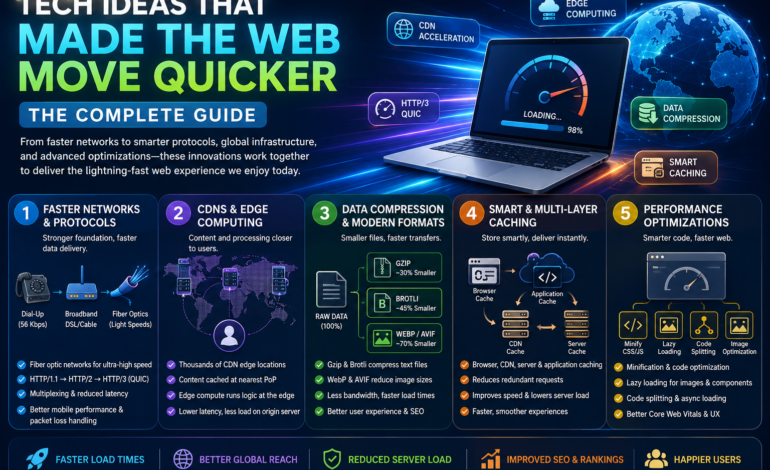
Early World Wide Web hypertext documents tak limited tha. Jab web designers ne custom fonts, high-resolution media, interactive scripts, aur styling elements include karna shuru kiye, to pages dynamic hotay gaye par internet slow hone laga. Latency, network congestion, aur browser execution delay ne users aur engineers ke liye challenges create kar diye.
Web ecosystem ko crash hone se bachane aur modern high-speed phase tak pohnchane ke liye global software engineers aur infrastructure providers ne system design mein radical transformations kiye. Network infrastructure se le kar browser rendering engines tak, har level par mechanical aur algorithmic improvements laayi gayin.
1. Evolution of Transport Infrastructure and Networking Protocols
Underlying network connection layers digital communication ka main backbone build karti hain. Protocols speed upgrades directly influence karte hain ke client machine kitne milli-seconds mein application data server se sync karti hai.
Dial-Up to Fiber Optics: Hardware Acceleration
Internet communication ka base hardware lines par dependent hota hai. Dial-up copper telephone connections audio-frequency channels use karte thay, jin ki maximum capability $56\text{ Kbps}$ thi.
Cable broadband, Digital Subscriber Line (DSL), aur subsea fiber optic cables ki introduction ne physical medium latency zero levels par shift kar di. Light-based data transfers ne physical infrastructure mein broadband internet throughput scale up kar diya.
[Dial-Up Copper (56 Kbps)] ---> [Broadband DSL/Cable] ---> [Subsea Fiber Optics (Light Speeds)]
Protocol Shift: HTTP/1.1 vs HTTP/2 vs HTTP/3
Protocol structure software side request pipeline manage karta hai:
- HTTP/1.1 Queuing Bottlenecks: HTTP/1.1 standard mein single
TCP/IPchannel par ek waqt mein sirf ek active data request handle hoti thi. Multiple CSS, JS, aur media files stream karne ke liye complex queuing order construct hota tha, jis se Head-of-Line (HOL) blocking issues create hotay thay. - HTTP/2 Multiplexing: 2015 mein HTTP/2 protocol multiplexing technique laya. Single network connection line par simultaneously multiple requests and responses send aur receive hone lagay, jis se network round-trips drop ho gaye.
- HTTP/3 and QUIC: HTTP/3 legacy TCP connection ko UDP-based QUIC protocol se replacement karta hai. UDP handshake delays drop karta hai, mobile packet loss handling resolve karta hai, aur rapid bandwidth output delivery establish karta hai.
2. Content Delivery Networks (CDNs) and Edge Computing
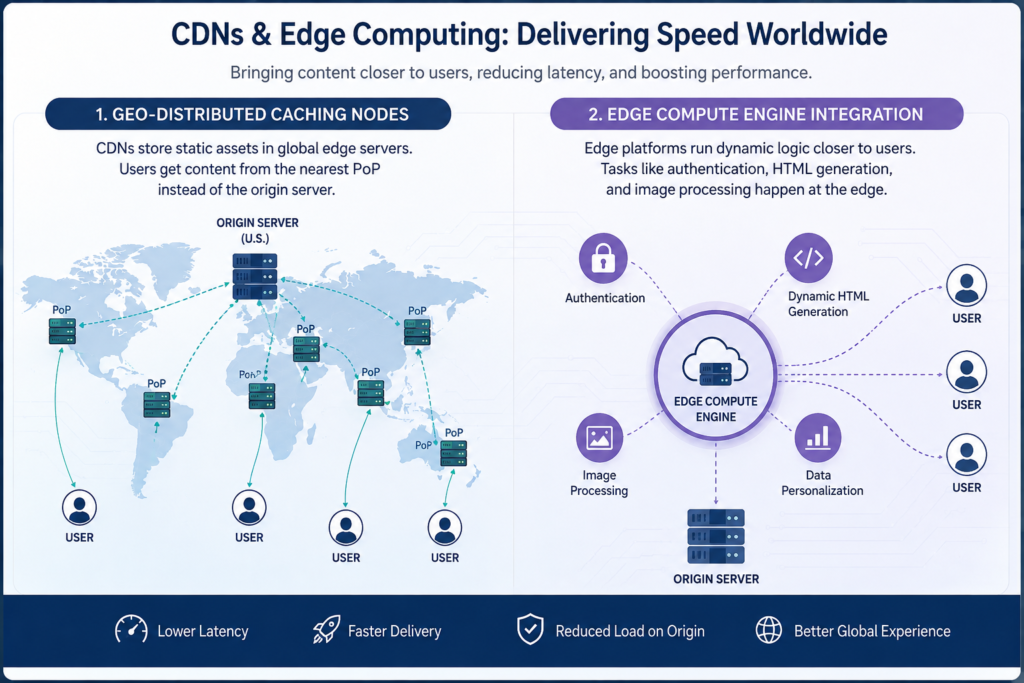
Geographical distance speed drop hone ka primary physical issue tha. Web application backend server if United States mein host ho aur end-user Pakistan se access kare, to packet travel physical limits ke waja se latency create karti thyn.
How content delivery networks speed up the web follows spatial localized distribution principles:
Geo-Distributed Caching Nodes
Content Delivery Networks (CDNs) globally thousands of distributed edge server nodes establish karte hain. Static assets (JS, CSS, images, video blocks) automatically user ke nearest Point of Presence (PoP) server location par cache ho jate hain. User query origin server par hit karne ke bajaye local city node se resolve ho jati hai.
Edge Compute Engine Integration
Modern edge computing platforms only static file serving tak limited nahi hain. Serverless functions (Cloudflare Workers, Fastly Edge) authentication logic, dynamic HTML generation, aur image processing workflows direct end-user ke geographical border par execute kar dete hain, jis se origin backend infrastructure server stress free ho jata hai.
3. Data Compression Standards and Advanced Media Formats
Network speed improve karne ka fast method data payload size compress karna hai. Smaller files network pipes se minimum time mein transfer hoti hain.
Raw Data Payload (100%)
  └── Gzip Engine ---> [30% Size Reduction]
  └── Brotli Algorithm ---> [45% Size Reduction]
  └── Next-Gen Format (WebP/AVIF) ---> [70% Media Size Reduction]
Text File Compression: Gzip vs Brotli
Web text formats (HTML documents, CSS files, JavaScript scripts) dynamic byte compression algorithms run karte hain:
- Gzip: Deflate compression model follow karta hai, jo text string patterns detect karke file footprint 60% se 70% decrease kar deta hai.
- Brotli Compression: Google ka developed Brotli compression system multi-dictionary algorithms utilize karta hai. Brotli text dynamic packets ko Gzip se 20% ziada compress karta hai, jo system response times fast banata hai.
Image Formatting Revolution: Modern Formats
Images traditional websites ka 60% to 70% data weight construct karti thyn. JPEG aur PNG formats file sizes expand kar dete thay:
- WebP: Modern WebP / AVIF formats lossy aur lossless compression mechanisms utilize karte hain. WebP baseline image weight 30% drop kar deta hai.
- AVIF (AV1 Image File Format): Modern AVIF format high dynamic range colors retain karte hue image file size ko PNG payload ke comparison mein 80% decrease kar deta hai, jo visual rendering output delay free banata hai.
4. Multi-Layered Caching Architecture
System operations skip karna optimization ka powerful programmatic logic hai. Server backend processes aur client network calls bypass karne ke liye layered caching architectures implement kiye gaye.
| Caching Layer | Location | Operational Mechanism | Latency Impact |
| Browser Caching | End-User Local Storage / Disk | Saves static resources locally | Ultra-low (0ms fetch time) |
| Service Worker Cache | Client Application Worker | Intercepts network calls offline/online | Instant client-side render |
| Edge CDN Cache | Geographically Local Data Centers | Serves global assets close to user | Low (5ms – 20ms fetch) |
| Server Object Cache | Origin Hosting Memory (Redis/Memcached) | Stores database queries in RAM | Drops backend DB delays |
Browser caching HTTP cache headers (Cache-Control, ETag, Expires) use karke static assets ko machine disk drive mein hold karta hai. Repeat visits origin server connect karne ke bajaye local drive se assets render karti hain.
5. Client-Side Rendering and Asynchronous Communication
Early 2000s era tak user action click (form submission, page change, category selection) direct full-page browser screen update demand karta tha. Browser full DOM tree kill karke new server HTML page request execute karta tha.
[Traditional Sync Web] -> Click -> Screen Wipe -> Full Server Reload -> Render Page
[Modern Async AJAX]   -> Click -> Background API Fetch -> Smooth Partial Update
AJAX Revolution
AJAX (Asynchronous JavaScript and XML) architecture ne client application workflow alter kiya. Web pages internal background data calls execute karte hain. Complete layout rebuild karne ke bajaye specific DOM components dynamic content update handle kar lete hain, jis se bandwidth network usage eliminate hota hai.
Single Page Application (SPA) Frameworks
React, Vue, aur Angular frameworks ne SPA rendering logic shift ki. Application shell start mein render hone ke baad client side JavaScript router engine full application run karta hai. Dynamic API payloads data render scale optimize kar dete hain.
6. Rendering Optimization and Script Execution Control
Modern browser layout engines HTML data ko visual display screen pixels mein render karte hain. Is sequence ko Critical Rendering Path (CRP) kaha jata hai.
HTML/CSS/JS Payload ---> DOM/CSSOM Tree ---> Render Tree ---> Layout Calculation ---> Pixel Paint
Removing Render-Blocking Resources
Standard HTML setup mein external script load hone tak visual rendering engine completely block ho jata tha.
- Async & Defer Attributes:
<script async>aur<script defer>HTML setup scripts download operations ko parallel execution pipeline mein shift karte hain. Main layout rendering execute hone se render-blocking resources bottleneck zero ho jata hai. - Lazy Loading Techniques:
lazy loadinglogic image elements aur secondary iframe components ko display window screen se bahar load hone se suspend rakhti hai. User scrolling activity perform karne par media background fetch operations execute hoti hain.
Technical Performance Measurement Standards (Core Web Vitals)
Google page ranking systems aur performance monitoring frameworks site speeds quantify karne ke liye clear technical benchmarks define karte hain:
- Largest Contentful Paint (LCP): Main visible content block load completion timing. Ideal benchmark $< 2.5\text{ seconds}$ hota hai.
- Interaction to Next Paint (INP): User action click response latency. Target threshold $< 200\text{ milliseconds}$ expected hota hai.
- Cumulative Layout Shift (CLS): Media elements positioning movement stability metric. Optimal score $< 0.1$ Maintain karna zaroori hai.
Comparative Analysis of Web Speed Eras
| Tech Era | Primary Bottleneck | Solution Introduced | Speed Improvement Scale |
| 1990s Dial-up Era | Physical Line Bandwidth ($56\text{ Kbps}$) | Broadband Broadband & DSL Lines | 10x Network Capacity |
| 2000s Web 2.0 Era | Page Reload Latencies | AJAX & Browser Caching | 5x App Responsiveness |
| 2010s Mobile Era | Multi-Request Queuing Issues | HTTP/2 Multiplexing & CDNs | 4x Request Parallelism |
| 2020s+ Modern Era | Main-Thread Blocking & Large Media | Brotli, WebP / AVIF, HTTP/3 | 3x Mobile Render Acceleration |
7. WebAssembly (WASM): Native Execution Speeds in the Browser
Traditional web browsers purely JavaScript, HTML, aur CSS parse karne tak limit thay. Complex web applications, photo/video editors, aur heavy web games browser load timings par severe processing delays create karte thay. Year 2017 mein WebAssembly (Wasm) introduction ne web performance landscape change kar diya.
Grid Dynamics+ 1
WebAssembly C++, Rust, aur Go jaise low-level languages ko compact, binary bytecode format mein convert karta hai jo modern browsers near-native speed par run karte hain. JavaScript execution overhead drop hone se heavy client-side computation instant execute hoti hai, jo heavy dynamic platforms execution speed accelerate karti hai.
Grid Dynamics+ 1
8. Predictive Preloading and Machine Learning Integration
Network calls manually execute karne se smart predictive systems proactive page fetching handle kar rahe hain. Early web development models static links par rely karte thay, jahan user link click karne ke baad network server data packet retrieval process initiate hota tha.
Speed Kit
Modern predictive preloading engines machine learning models integrate karte hain. Web platforms mouse cursor movement, hover tracking, aur scroll viewport analysis se user ke next page click intent calculate kar lete hain. Background execution engines link click hit hone se micro-seconds pehle target payload download kar lete hain, jis se user UI interaction near 0ms navigation latency deliver karti hai.
Speed Kit
9. Server-Side Rendering (SSR) and Hybrid Rendering Architecture
Single Page Applications (SPAs) client-side dynamic capabilities scale karti thyn, par heavy JavaScript bundles compile hone par high Time to First Byte (TTFB) aur execution lag issue develop ho jata tha.
Webflow Atelier
Hybrid rendering solutions—jaise Server-Side Rendering (SSR) aur Incremental Static Regeneration (ISR)—ne full computational responsibility origin or edge servers par reverse assign kar di. Server preliminary structural HTML frame compute karke instantly complete document deliver karta hai. Browser JavaScript asset parse hone se pehle HTML UI tree immediately draw kar deta hai, jisse initial visual load times aur Interaction to Next Paint (INP) score dramatically.