
The Ultimate ALR Projector Screen Guide: Transforming Bright Living Rooms and Home Theaters into Cinematic Masterpieces

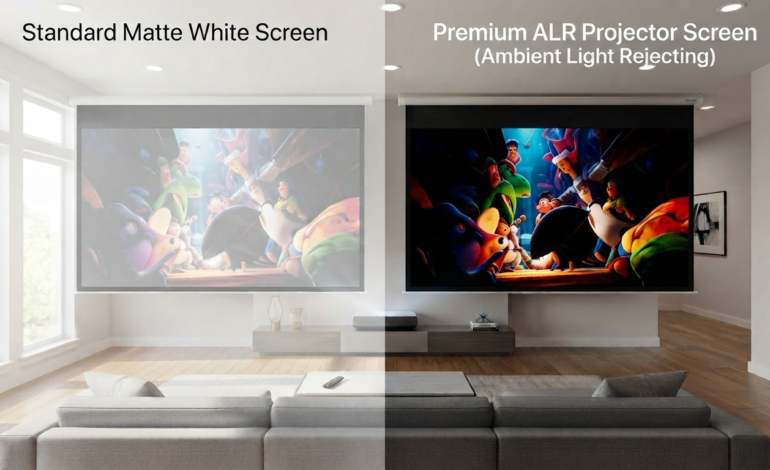
Welcome to the definitive guide on maximizing your home entertainment setup with an alr projector screen. If you have ever tried watching a film on a traditional white projection surface with your living room lights turned on, you already know the frustrating result: a washed-out, milky image that lacks contrast, punch, and depth. For decades, achieving a true cinematic experience meant transforming your living space into a pitch-black cave, meticulously blocking out every stray beam of daylight. Fortunately, modern optical engineering has completely revolutionized home entertainment. Today, investing in an alr projector screen allows you to enjoy vibrant, high-contrast visuals even in rooms flooded with ambient daylight.
Whether you are designing a dedicated basement cinema or upgrading your bright open-concept living room with a state-of-the-art 4K laser TV, understanding how ambient light rejection works is the key to unlocking your projector’s true potential. In this comprehensive guide, we will explore the optical technology behind these specialized surfaces, compare various physical styles, evaluate pricing tiers, and help you select the ideal model for your unique entertainment space.
What is an ALR Projector Screen and How Does It Work?
To appreciate why an alr projector screen is an absolute game-changer, you first need to understand how standard projection surfaces behave. A standard matte white screen acts like a blank canvas; it scatters any light that hits it in every possible direction—including ambient light from windows, lamps, and overhead fixtures. This indiscriminate scattering effect washes out dark black levels, destroying contrast and making images look dull and lifeless.
An ambient light rejecting screen, on the other hand, utilizes specialized optical filtering layers designed to selectively reflect light while rejecting unwanted room illumination.
The Physics of Ambient Light Rejection
- Angular Reflectivity: Many ALR designs use microscopic physical structures (such as lenticular lenses or microscopic saw-tooth grooves) that capture light originating from a specific angle—typically from a tabletop ultra short throw projector—while deflecting light coming from above or the sides.
- Diffusion and Absorption: Other variants incorporate microscopic light-absorbing particles (often carbon-infused layers) that absorb ambient room light while bouncing the concentrated beam from your projector straight back toward the audience.
- Gain and Contrast Enhancement: By suppressing ambient glare, these surfaces drastically improve black levels, resulting in a high contrast projector screen experience that rivals traditional flat-panel televisions.
ALR Screen vs Regular Screen: Why Traditional Options Fail
Choosing between an alr screen vs regular screen ultimately comes down to your room’s lighting conditions and viewing habits. While traditional white or matte grey screens are budget-friendly and perform wonderfully in completely light-controlled dedicated home theaters, they become practically useless the moment you turn on a reading lamp or open a window blind.
| Feature | Regular White/Grey Screen | ALR Projector Screen |
| Ambient Light Handling | Poor (washes out easily) | Excellent (rejects overhead/side light) |
| Contrast Levels | Low in lit rooms; High in dark rooms | Consistently high across various lighting conditions |
| Ideal Environment | Dedicated blacked-out home theater | Living rooms, media rooms, offices, daylight spaces |
| Projector Pairing | Standard long-throw or short-throw | Optimized for UST, laser, or standard throw |
| Price Point | Generally affordable | Premium investment |
When comparing an alr screen vs white screen, you must consider your lifestyle. If you only watch movies late at night with all the curtains drawn, a traditional white surface is a fine, economical choice. However, if you want to watch sports on a Sunday afternoon with the blinds open, an ambient light rejecting projector screen is non-negotiable.
Types of ALR Projector Screens
When shopping for a home theater projector screen, you will encounter several mechanical and structural configurations. Selecting the right physical format depends heavily on your room layout and interior design preferences.
1. Fixed Frame ALR Projector Screen
The fixed frame alr projector screen is the gold standard for dedicated media rooms and permanent home theater installations. Much like a canvas painting, the specialized optical material is stretched tightly across an aluminum frame, ensuring a completely flat, wrinkle-free surface for life. This tension is crucial for maintaining crisp geometry, especially when paired with high-end 4K projector screen setups.
2. Motorized and Retractable ALR Options
If your projection surface shares space with a wall-mounted television or you simply prefer a clean aesthetic when the system is turned off, a motorized alr projector screen or retractable alr projector screen is the ideal solution.
- Wall Mounted & Ceiling Mounted: These units roll up into a sleek casing mounted discreetly to your wall or ceiling, dropping down automatically via remote control or trigger wires when powered on.
- Tab-Tensioning: High-end motorized options feature side tension cords (tab-tensioning) to keep the flexible optical material taut and prevent curling over time.
Matching Your Setup: UST vs Standard Throw ALR Screens
Not all ALR surfaces are created equal. The correct choice depends entirely on where your projector is placed relative to the screen.
Ultra Short Throw (UST) ALR Screens
An ultra short throw projector screen (often called a UST ALR screen) is engineered specifically for laser TVs that sit just inches away from the wall underneath the display. These surfaces feature specialized micro-structures designed explicitly to capture light coming upward from below while rejecting ambient light from overhead ceiling fixtures and side windows. If you are using a modern laser TV, buying a dedicated best ALR screen for ultra short throw projector is mandatory to achieve vivid daytime viewing.
Standard Throw Laser Projector Screens
If your projector is mounted across the room on the back wall or ceiling, you will need a standard-throw laser projector screen or daylight projector screen. These materials rely on angular reflectivity to bounce light coming from the rear of the room directly toward the seating positions while scattering off-axis room light away from the viewers.
Key Benefits of Upgrading to a High Contrast Projector Screen
Investing in a bright room projector screen offers several distinct performance advantages over standard display methods:
- Uncompromised Daylight Viewing: Enjoy your favorite shows, movies, and gaming sessions without needing to plunge your home into total darkness.
- Deep Black Levels: By rejecting ambient room light, dark scenes retain their shadow detail rather than looking grey and washed out.
- Enhanced Color Saturation: Contrast is the backbone of color perception. A contrast enhancing screen makes colors pop with vivid realism, making HDR content truly shine.
- Cinematic Scale: Even the largest flat-panel TVs max out at around 98 inches and are difficult to transport and install. An alr screen for projector lets you easily achieve a massive 100-inch to 150-inch cinematic image.
Is an ALR Projector Screen Worth It? Cost vs. Benefit Analysis
A common question among buyers is: Is an ambient light rejecting projector screen worth the investment?
Because of the complex multi-layer optical manufacturing processes involved, an alr projector screen price is noticeably higher than a traditional matte white or grey fabric. While a basic manual white screen can cost a couple of hundred dollars, a premium fixed frame alr projector screen for 4K can range from several hundred to a few thousand dollars depending on size and brand.
If your viewing environment has controlled lighting and you never turn on lights while watching movies, you might not strictly need one. However, if your room features white walls, large windows, or active family traffic, an alr projector screen for home theater or living room use is unquestionably worth every penny. Without it, you are wasting a significant portion of your projector’s brightness and contrast potential.
How to Choose the Best ALR Projector Screen (Buying Guide 2026)
Navigating the market for the best ALR projector screen for bright rooms requires evaluating several critical factors:
- Projector Type: Determine whether you have an Ultra Short Throw (UST) laser TV or a standard/long-throw projector. Never mix up UST and standard ALR materials, as they use completely opposing optical reflection properties.
- Gain Rating: Look for a projector screen gain rating between 0.6 and 1.5. UST ALR screens typically have a gain around 0.6 to 0.8, which optimizes contrast by aggressively absorbing ambient light, while relying on the extreme brightness of laser TVs to maintain image punch.
- Room Lighting Layout: Analyze where your primary light sources are located. If overhead recessed lighting is your main issue, prioritize a screen with superior top-down light rejection.
- Screen Size and Format: Ensure the aspect ratio (typically 16:9 for home theater and gaming, or 2.1:1/2.35:1 for cinematic scope) matches your content library.
For internal recommendations and further reading on home automation integration, check out our guide on Smart Home Theater Automation Strategies. To compare specific hardware models, visit our detailed 2026 Projector and Screen Hardware Database. For external industry insights, you can also explore expert reviews on ProjectorCentral.
Installation Tips and Best Practices
Proper installation is critical for getting the best performance out of your alr screen installation for home theater projects.
- Precision Alignment: With UST ALR screens, alignment is critical. Even a slight misalignment between the projector and the screen can cause hot-spotting or uneven brightness distribution.
- Wall Structural Support: Fixed frame and motorized options can be surprisingly heavy. Ensure you anchor mounting brackets directly into wall studs or use heavy-duty toggle bolts for drywall security.
- Control Room Reflections: To maximize the contrast benefits of your home cinema screen, consider painting nearby walls and ceilings in darker, matte colors to minimize secondary light bounce.
Conclusion
Upgrading your entertainment setup with a premium alr projector screen transforms how you experience movies, sports, and gaming in everyday living spaces. By successfully combating ambient glare and elevating contrast levels, these specialized optical surfaces bridge the gap between traditional television performance and massive cinematic scale. Assess your room’s lighting, match your projector throw distance correctly, and invest in a quality ambient light rejecting surface to enjoy breathtaking visuals any time of day.