Google Ads Updates 2026: Latest Changes, AI Features & What Advertisers Need to Know

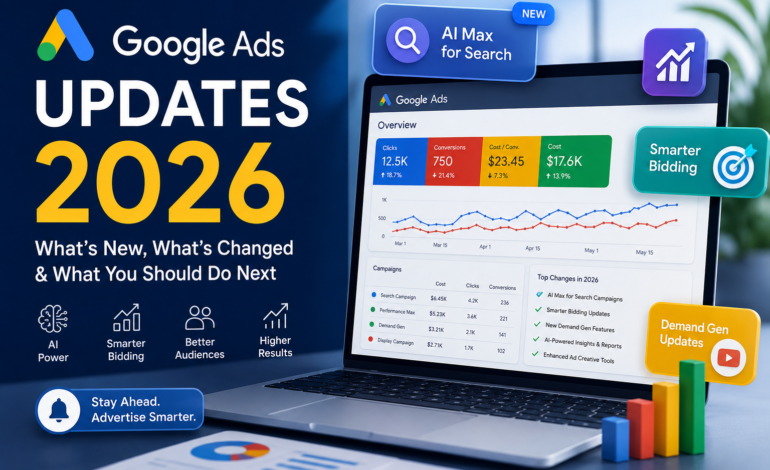
Google Ads continues to evolve rapidly in 2026 as artificial intelligence, automation, advanced bidding, and new advertising formats become increasingly important to digital marketing. The platform is moving beyond traditional keyword-based advertising toward systems that use real-time signals, AI-generated assets, audience insights, and automated campaign optimization.
For advertisers, these changes are more than simple interface updates. They can affect campaign structure, bidding strategies, keyword targeting, creative development, reporting, and the way businesses manage advertising budgets. Understanding the latest can therefore help marketers make better decisions and avoid relying on outdated campaign practices.
This guide explains the most importantin 2026, what has changed, why the changes matter, and how advertisers can prepare their campaigns for the current environment.
Table of Contents
- What Are the Latest in 2026?
- AI Max for Search Campaigns
- Dynamic Search Ads Are Moving Toward AI Max
- Changes to Google Ads Bidding Strategies
- New Target-Based Bidding Changes
- AI-Powered Tools for Google Ads and Analytics
- Demand Gen Campaign Updates
- New AI Advertising Experiences
- Changes to Display Campaigns
- AI-Generated Ad Content and Transparency
- How Google Ads Is Changing Keyword Targeting
- What These Updates Mean for Advertisers
- How to Prepare Google Ads Campaigns for 2026
- Google Ads Optimization Checklist
- Frequently Asked Questions
- Conclusion
What Are the Latest in 2026?
Google Ads is increasingly centered around artificial intelligence and automated optimization. Several major changes announced or rolled out during 2026 affect Search campaigns, bidding, creative assets, Demand Gen, Display campaigns, reporting, and campaign management.
Some of the most important developments include the wider rollout of AI Max for Search campaigns, changes to target-based bidding, new AI-powered reporting and workflow features, improvements to Demand Gen, and changes in how legacy campaign features are being transitioned.
Google has also announced that some existing Dynamic Search Ads, automatically created assets, and campaign-level broad match configurations will move toward AI Max. However, the transition timeline is not identical for every feature. Google has extended the Dynamic Search Ads sunset and automatic upgrade timeline to February 2027, while certain other configurations are scheduled for automatic upgrades beginning in September 2026.
The overall direction is clear: Google Ads is becoming more automated, but advertisers still need to provide strong business inputs, accurate conversion data, relevant landing pages, quality creative assets, and appropriate controls.
AI Max for Search Campaigns
One of the biggest in 2026 is the expansion of AI Max for Search campaigns.
AI Max is designed as an optimization layer for Search campaigns. It combines different AI-powered capabilities, including search term matching, text customization, and final URL expansion, to help campaigns respond to a wider range of user searches.
According to Google, AI Max can use signals from advertiser-provided information, website content, landing pages, existing ads, and search intent. The objective is to identify additional relevant opportunities while maintaining controls around areas such as branding and location.
Key AI Max Features
| Feature | Purpose |
|---|---|
| Search term matching | Helps identify additional relevant search opportunities |
| Text customization | Creates additional ad assets based on campaign context |
| Final URL expansion | Can direct users to more relevant pages |
| Brand controls | Helps advertisers manage brand-related matching |
| Location controls | Provides additional geographic steering |
| Asset optimization | Helps adapt messaging to user intent |
AI Max does not mean advertisers can simply launch a campaign and ignore it. Campaign inputs remain important because AI systems work from the information, signals, assets, conversion goals, and website content available to them.
A strong landing page and accurate conversion tracking therefore remain essential even when more campaign decisions are automated.
Dynamic Search Ads Are Moving Toward AI Max
Dynamic Search Ads have traditionally helped advertisers discover search traffic by using website content to dynamically generate ad headlines and landing-page connections.
Google is now transitioning this functionality toward AI Max. The company originally announced automatic upgrades beginning in September 2026, but later extended the Dynamic Search Ads sunset and automatic upgrade timeline to February 2027.
At the same time, Google states that campaigns using automatically created assets and campaign-level broad match settings will begin automatic upgrades to AI Max starting in September 2026.
This distinction is important because advertisers should not treat every legacy feature as having the same deadline.
What Advertisers Should Do
Before automatic changes affect an account, advertisers should review:
- Existing Search campaign structure
- Dynamic Search Ads
- Automatically created assets
- Broad match settings
- Conversion tracking
- Landing pages
- Search term performance
- Negative keyword strategy
- Brand controls
- Location targeting
- Budget allocation
The goal should not simply be to avoid automation. Instead, campaign managers should understand which controls remain available and make sure the information supplied to Google Ads accurately represents business objectives.
Changes to Google Ads Bidding Strategies
Bidding is another major area receiving attention in 2026.
Google Smart Bidding uses AI to set bids for individual auctions based on the likelihood of achieving a conversion or conversion value. The major strategies include Target CPA, Target ROAS, Maximize Conversions, and Maximize Conversion Value.
Google also changed the way some Smart Bidding strategies are labeled during 2026.
For example, the previous wording “Maximize conversions with a Target CPA” is being presented as “Target CPA,” while “Maximize conversion value with a Target ROAS” is being presented as “Target ROAS.” Google states that the underlying bidding behavior remains the same, so the naming change itself does not require advertisers to take action.
Why Bidding Changes Matter
The important issue is not the name of the strategy. The bigger consideration is how bidding systems interact with campaign goals, budgets, conversion data, and target settings.
A campaign optimized toward poor-quality conversion actions can still produce inefficient results even when advanced AI bidding is enabled.
For this reason, conversion quality should remain a major part of Google Ads management.
New Target-Based Bidding Changes
Another important 2026 development affects target-based bidding.
Google began rolling out changes to target-based bid strategies on August 17, 2026. The update is intended to make performance more consistent and predictable when advertisers make budget adjustments. Google has also introduced a Bid Target Adjustment Tool to help advertisers review and adjust targets.
The rollout is gradual, meaning accounts may not all experience the change at exactly the same time.
Advertisers should pay particular attention to campaigns that are limited by budget. Google recommends reviewing campaign settings and ensuring that targets continue to match business objectives, especially where previous campaign performance was affected by budget limitations.
Practical Bidding Review
A useful bidding review should consider:
- Current conversion volume
- Conversion value
- Target CPA or Target ROAS
- Available campaign budget
- Recent performance trends
- Conversion quality
- Seasonal demand
- Changes in customer behavior
Increasing a budget without reviewing the target can produce a different outcome than expected. Likewise, changing a target too aggressively can affect the volume of eligible traffic.
AI-Powered Tools for Google Ads and Analytics
Google is also introducing additional AI-powered experiences across Google Ads and Google Analytics.
In August 2026, Google announced new tools designed to simplify marketing workflows. These include AI-powered summaries, visual reports generated through simple text prompts, and benchmarking features that allow businesses to compare performance against similar businesses.
These tools are particularly useful for advertisers dealing with large amounts of campaign data.
Instead of manually reviewing every metric, marketers can increasingly use AI-assisted interfaces to identify patterns and summarize performance.
However, automated analysis should support decision-making rather than replace it. Important business decisions still require context such as profit margins, customer lifetime value, lead quality, sales cycles, and offline conversion information.
Demand Gen Campaign Updates
Demand Gen is another area receiving significant attention in 2026.
Google’s August 2026 Demand Gen update introduced new tools designed to help advertisers generate high-quality leads and acquire customers across YouTube and other Google surfaces. The update includes new messaging, travel, and creative capabilities.
Google reported that improvements introduced during the second half of 2025 were associated with an average 30% increase in conversions or conversion value for advertisers using Demand Gen, although individual campaign results can vary significantly.
The larger trend is that Demand Gen is becoming a more sophisticated environment for visual and audience-driven advertising.
For brands, this means creative quality is increasingly important.
Demand Gen Best Practices
Strong Demand Gen campaigns should combine:
- Clear visual communication
- Relevant audience signals
- Strong offers
- Mobile-friendly landing pages
- Multiple creative variations
- Accurate conversion tracking
- Consistent brand messaging
- Regular performance analysis
Creative testing should focus on meaningful differences rather than producing many nearly identical advertisements.
New AI Advertising Experiences
Google has also announced new advertising experiences designed specifically for the AI era of Search.
At Google Marketing Live 2026, Google introduced new ad formats built with Gemini and expanded initiatives designed to help advertisers connect with consumers in changing search experiences.
This reflects a broader transformation in search behavior.
People are increasingly using conversational queries and AI-assisted search experiences to research products, compare options, and make decisions. Advertising systems therefore need to understand intent beyond a simple keyword-to-ad relationship.
For marketers, this means content, landing pages, product information, brand messaging, and conversion signals all become more important.
Changes to Display Campaigns
Google is also simplifying the Display campaign experience.
The updated Display campaign environment gives advertisers access to Google’s AI capabilities while providing controls over bidding, creatives, and audiences. Google is also consolidating certain targeting functionality under optimized targeting.
Another important development is the relationship between Display and Demand Gen.
Google has announced that Google Display Network inventory is becoming available through the Demand Gen campaign environment, while the existing Display network continues to provide access to a broad range of websites and apps. The migration is being rolled out in phases.
Advertisers should therefore pay attention to campaign creation options and account notifications as the transition develops.
AI-Generated Ad Content and Transparency
As AI-generated content becomes more common in advertising, transparency is also becoming more important.
Google updated its AI labeling requirements in July 2026. Advertisers can add text or visual labels to image and video assets that were generated or modified using AI, and Google may automatically apply labels to certain assets generated through its AI tools.
This is especially relevant for advertisers operating in regions where laws or regulations require disclosure of AI-generated or digitally altered content.
Advertisers should therefore consider transparency during the creative production process rather than treating labeling as an afterthought.
How Google Ads Is Changing Keyword Targeting
Traditional Google Ads management often focused heavily on selecting keywords and matching them with advertisements.
That approach is becoming less complete.
Modern Google Ads systems can use search intent, landing page content, ad assets, audience signals, and automated matching technologies to identify potential opportunities.
AI Max, for example, uses search term matching technology alongside asset and landing-page information.
This does not mean keywords are no longer important. Keywords still provide valuable information about customer intent and campaign organization.
The difference is that keywords are increasingly becoming one input among several rather than the only mechanism used to determine which searches can trigger advertising.
What These Updates Mean for Advertisers
The 2026 Google Ads environment can be summarized through five major shifts.
| Area | Earlier Approach | Current Direction |
|---|---|---|
| Targeting | Heavy keyword dependence | AI + intent + signals |
| Ad creation | Mostly manual assets | Manual + AI-assisted assets |
| Bidding | Manual optimization | Increasingly automated |
| Reporting | Manual analysis | AI-assisted insights |
| Campaign management | Separate tools and features | More integrated AI systems |
The biggest lesson is that automation does not eliminate the need for strategy.
Instead, the role of the advertiser is changing.
Campaign managers increasingly need to provide high-quality inputs and evaluate whether Google’s automated decisions align with actual business outcomes.
How to Prepare Google Ads Campaigns for 2026
Preparing for the latest updates should begin with campaign fundamentals.
1. Audit Conversion Tracking
Conversion tracking should accurately represent valuable business actions.
For lead-generation campaigns, this might mean distinguishing qualified leads from simple form submissions. For ecommerce, revenue and purchase data are particularly important.
Poor conversion data can reduce the quality of automated optimization.
2. Review Landing Pages
AI-powered advertising systems increasingly use website and landing-page information.
Every important landing page should therefore have:
- Clear messaging
- Relevant information
- Strong page structure
- Fast loading performance
- Mobile usability
- A clear conversion path
- Content that matches the advertisement
3. Review Search Campaigns
Identify campaigns using older features that may be affected by upcoming transitions.
Check Dynamic Search Ads, automatically created assets, campaign-level broad match settings, and AI Max eligibility.
4. Improve Creative Assets
AI can generate and customize advertising assets, but the underlying brand information still matters.
Provide clear headlines, descriptions, images, videos, product information, and landing pages so automated systems have strong material to work with.
5. Monitor Search Terms
Even with advanced automation, search-term analysis remains valuable.
Look for irrelevant queries, unexpected intent, poor-quality traffic, and opportunities that deserve dedicated campaigns.
6. Review Budgets and Targets
Budget changes should be considered together with bidding targets.
The 2026 target-based bidding changes make this particularly important for campaigns that are limited by budget.
7. Use AI as an Optimization Layer
AI should be treated as a tool for improving campaign management rather than a replacement for marketing strategy.
Business goals, profitability, customer quality, brand positioning, and market knowledge still require human judgment.
Google Ads Optimization Checklist
Before considering a campaign fully optimized, review the following:
- Conversion tracking is accurate
- Primary conversions represent real business value
- Landing pages match ad intent
- Search terms are monitored
- Negative keywords are reviewed
- Campaign budgets match business priorities
- Bidding targets are realistic
- Ad assets are varied and relevant
- Brand controls are reviewed
- Location targeting is accurate
- AI Max settings are understood
- Older campaign features are identified
- Demand Gen creative is tested where appropriate
- AI-generated assets meet applicable disclosure requirements
- Campaign performance is reviewed regularly
Frequently Asked Questions
What is the biggest Google Ads update in 2026?
One of the most significant developments is the expansion of AI Max for Search campaigns. AI Max combines capabilities such as search term matching, text customization, and final URL expansion to help Search campaigns find and respond to additional opportunities.
Are Dynamic Search Ads being removed?
Google is transitioning Dynamic Search Ads toward AI Max. The timeline has been extended, with the Dynamic Search Ads sunset and automatic upgrade now scheduled to begin in February 2027. Other features, including automatically created assets and campaign-level broad match settings, have separate September 2026 upgrade timelines.
Did Google change Smart Bidding in 2026?
Google changed the naming of some Smart Bidding strategies during 2026, but stated that the underlying bidding behavior remains the same. Target CPA and Target ROAS are now used as simpler names for certain strategies.
What changed in Google Ads bidding in August 2026?
Starting August 17, 2026, Google began rolling out changes to target-based bidding designed to provide more consistent and predictable performance when budgets change. A Bid Target Adjustment Tool is also available to help advertisers adjust targets.
Is Google Ads becoming more automated?
Yes. Google is increasingly incorporating AI into targeting, bidding, creative generation, reporting, and campaign management. However, advertisers still control important business inputs such as goals, budgets, assets, website content, geographic settings, and campaign strategy.
Should advertisers use AI Max?
AI Max can be considered when its targeting and creative capabilities align with campaign objectives. Before enabling or relying on it, advertisers should review conversion tracking, landing pages, brand controls, search-term quality, and budget availability.
Are AI-generated Google Ads required to be labeled?
Certain AI-generated or AI-modified advertising assets may require labeling depending on the applicable regulations and circumstances. Google introduced AI labeling capabilities in 2026 to support transparency requirements.
Conclusion
The latest in 2026 show a clear movement toward AI-powered advertising. Search campaigns are becoming more intent-driven, bidding is becoming increasingly automated, creative production is gaining AI assistance, and campaign management is becoming more integrated with intelligent reporting and optimization tools.
For advertisers, the most important response is not simply to activate every new feature. A stronger approach is to understand how each update affects targeting, bidding, creative assets, landing pages, measurement, and business objectives.
The fundamentals still matter: accurate conversion tracking, relevant landing pages, useful advertising messages, appropriate budgets, strong creative assets, and continuous performance analysis. AI can help process signals and automate decisions, but the quality of the inputs remains critical.
As Google Ads continues to evolve through 2026 and into 2027, advertisers who understand both the technology and the fundamentals of performance marketing will be better positioned to adapt to changes without sacrificing campaign quality or business outcomes.